Access Control Installation
What Business Owners in Manchester Should Know About Access Control Compliance
Understand the legal frameworks, safe entry compliance checks, and security system responsibilities every Manchester business owner needs to manage access control properly.
Table of contents
For business owners managing restricted areas within their premises, understanding access control compliance requirements is no longer optional. Whether you run a small office in the city centre or a multi-site warehouse operation across Greater Manchester, the rules governing who can enter your building, how those entries are recorded, and how long that data is kept have become increasingly layered and consequential. Getting this wrong carries real risks, from regulatory penalties to liability exposure in the event of a security incident.
Compliance does not have to feel overwhelming. With the right foundation in place, access control security and compliance planning becomes a structured, manageable part of running a responsible business. This article walks you through the legal frameworks you need to be aware of, the practical checks you should carry out, and how professional support can help you stay on the right side of your obligations from day one.
Why Access Control Compliance Matters for Your Business
Many business owners install an access control system thinking the job ends when the hardware is in place. In practice, the installation is only the starting point. Compliance extends into how you manage credentials, how you record entry events, and how you respond when something goes wrong. Regulators and insurers alike are increasingly focused on whether businesses can demonstrate that their systems are actively managed, not just physically present.
According to research cited by Indusface Blog, 85% of executives surveyed say compliance requirements have become more complex over the past three years. For business owners without a dedicated compliance team, that complexity can translate into unintentional gaps with serious consequences, including regulatory scrutiny, personal liability for directors, and practical vulnerabilities that increase the risk of theft, data breaches, or workplace incidents.
Compliance, when approached correctly, supports your business rather than constraining it. The same research finds that 77% of global C-suite leaders believe compliance contributes significantly or moderately to achieving business goals. A well-managed access control setup gives you documented proof that your premises are secure, which matters when tendering for contracts, satisfying insurers, or protecting the trust of your staff and clients.

What Legal Frameworks Apply to Door Access and Building Entry in the UK?
Door access legal considerations for Manchester businesses sit across several overlapping frameworks rather than a single piece of legislation. The most commonly relevant include:
- UK GDPR and the Data Protection Act 2018: These govern how access records are collected, stored, and disclosed, and are enforced by the Information Commissioner’s Office.
- Health and Safety at Work Act 1974 and associated regulations: These require employers to restrict hazardous areas to authorised personnel and maintain safe conditions across all parts of their premises.
- Sector-specific standards: PCI-DSS applies to businesses handling payment data; ISO 27001 sets broader information security expectations; SIA licensing requirements may apply depending on how your security arrangements are structured.
Which frameworks apply to your business depends on your sector, your premises type, and the nature of the data you process. Most business owners are affected by at least two of these simultaneously.
| Framework | What It Covers | Who It Applies To | Enforcing Body |
|---|---|---|---|
| UK GDPR / Data Protection Act 2018 | Collection, storage, and disclosure of access records as personal data | Any business logging identifiable entry events | Information Commissioner’s Office (ICO) |
| Health and Safety at Work Act 1974 | Restricting hazardous or restricted areas to authorised personnel | All employers with restricted or dangerous zones | Health and Safety Executive (HSE) |
| PCI-DSS | Physical access controls protecting payment card data environments | Businesses that handle or store payment card data | PCI Security Standards Council |
| ISO 27001 | Broader information security management, including physical access | Businesses seeking or maintaining ISO certification | Accredited certification bodies |
| SIA Licensing | Licensing of security operatives and certain security arrangements | Businesses using door supervisors or security personnel | Security Industry Authority (SIA) |
How Do Privacy Laws Affect Access Records?
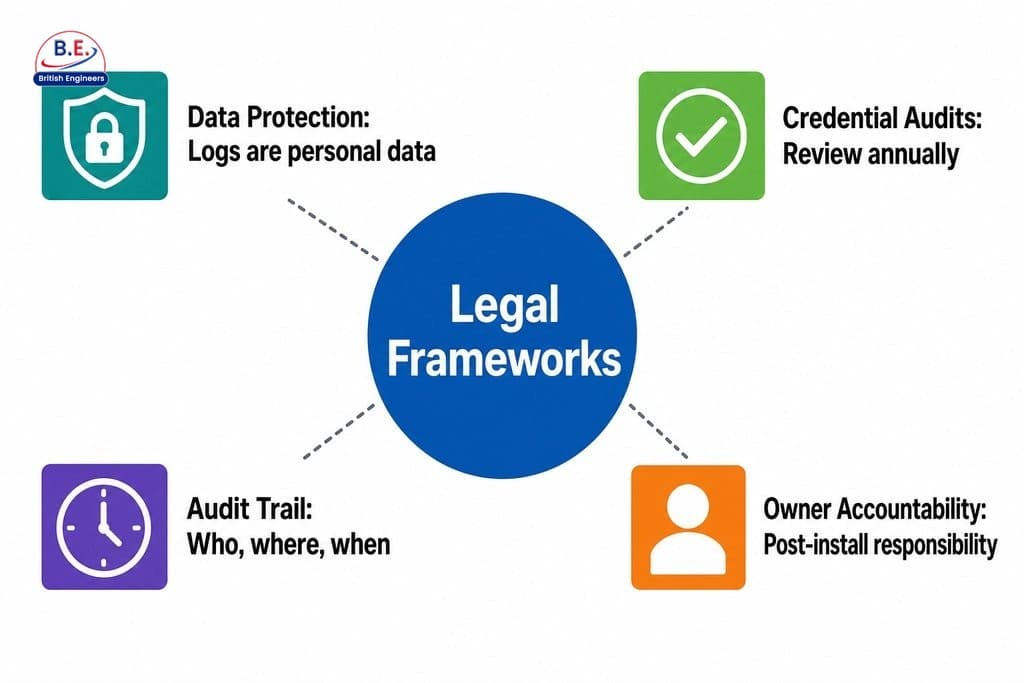
One of the most widely misunderstood aspects of access control compliance is knowing when access logs become personal data. Under UK GDPR and the Data Protection Act 2018, any record that can identify an individual, including a timestamped entry log linked to a named employee or a visitor badge with a name and photo, qualifies as personal data and must be handled accordingly.
Your access control system is therefore not just a security tool; it is also a data processing system that requires a lawful basis, a defined retention period, and a clear disclosure in your privacy policy. In practical terms, this means deciding how long you genuinely need to keep access records and deleting them once that purpose has been fulfilled, informing staff in writing that their building entries are logged, and making visitors aware of what data is captured at entry.
Data protection for access control records is a dedicated subject worth exploring in its own right, but the core obligation is straightforward: treat access logs with the same data governance discipline you would apply to any other personal data your business holds.
What Are Your Health and Safety Obligations Around Building Access?
Under UK health and safety legislation, employers have a duty to ensure that hazardous or restricted areas are accessible only to those with the appropriate authorisation and training. This applies across all types of premises in Manchester, whether you operate a manufacturing unit in Trafford Park, a logistics facility near the airport, or a professional services office in Spinningfields. An access control system plays a direct role in meeting this obligation by preventing unauthorised entry to server rooms, chemical storage areas, machinery zones, or any location where unrestricted access could result in harm.
Access control also connects to fire evacuation planning in a way that is frequently overlooked. If your system can restrict movement through a building, it must also be configured to release in an emergency so that escape routes are never blocked. Your system’s occupancy tracking or roll call capability must be reliable and regularly tested, since you need to account for everyone on your premises during an evacuation.
Safe Entry Compliance Checks: What Should You Verify Before an Audit?
Many businesses discover their most significant gaps not in the hardware itself but in the processes surrounding it, such as credentials never removed when an employee left, visitor access never formally terminated, or entry events logged but never reviewed. A practical set of safe entry compliance checks should cover:
- Confirming that all active credentials are tied to current, authorised users and that former employees or contractors have had access removed promptly.
- Verifying that entry and exit events are being logged consistently and that those logs are stored securely with a defined retention period.
- Checking that access permissions are reviewed at regular intervals, not just when a problem arises.
- Ensuring that visitor access is formally managed, with sign-in records that meet your data protection obligations.
- Confirming that your system documentation is up to date and accessible in the event of an audit or incident investigation.
According to MetricStream via Zluri’s compliance statistics compilation, 48% of organisations do not have a comprehensive list of all third parties with access to their network or premises. For Manchester businesses operating in shared buildings or working with regular contractors, this is a particularly common and costly oversight.
| Compliance Check | What to Verify | Risk if Overlooked |
|---|---|---|
| Active credential audit | All credentials belong to current, authorised users; former staff and contractors removed promptly | Unauthorised access; management liability |
| Entry and exit logging | Events logged consistently; logs stored securely with a defined retention period | Unable to demonstrate compliance or investigate incidents |
| Scheduled permission reviews | Access rights reviewed at regular intervals, not only after problems arise | Outdated permissions accumulate; audit gaps emerge |
| Visitor access management | Sign-in records maintained; visitor data handled per data protection obligations | UK GDPR breach; untracked third-party access |
| System documentation currency | Configuration records, user management procedures, and maintenance schedules up to date | Fails audit review; delays incident investigation |
| Third-party access inventory | Comprehensive list of all contractors and third parties with premises or network access | Unmonitored access; shared-building compliance gaps |

Who Is Accountable for Access Control on Your Premises?
A clear understanding of security system responsibility is essential for any business owner who has hired a contractor to install or maintain their access control setup. The installer carries professional responsibility for the quality and technical compliance of the installation itself. The ongoing management of that system, including who holds credentials, how access is reviewed, how records are stored, and how the system is maintained, falls squarely on the business owner or premises manager.
This distinction matters because it affects how liability is apportioned in the event of an incident. If an unauthorised person gained access because a former employee’s credential was never deactivated, that is a management failure, not an installation defect. Business owners should request full documentation from their installer, including system configuration records, user management procedures, and maintenance schedules. They should then take active ownership of the processes those documents describe and schedule regular access reviews and periodic system audits, since these responsibilities persist long after the engineer leaves the site.
Does Compliance Apply the Same Way to Every Type of Business in Manchester?
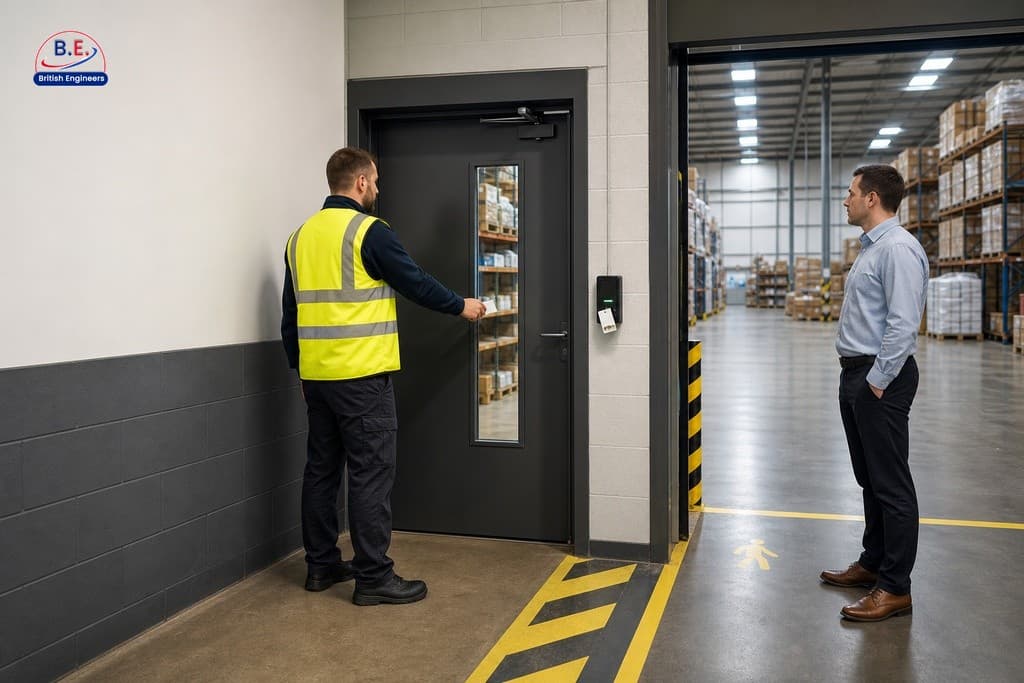
Building access compliance does not apply uniformly across all premises. The requirements vary significantly depending on your business type. Offices with a single entry point and a small, stable team have relatively straightforward requirements. Warehouses with multiple access zones, shift workers, and third-party logistics contractors face more layered obligations. Retail units require a clear separation between customer-accessible spaces and staff-only or stock areas, each governed by different access rules. Multi-tenant buildings add a further layer of complexity, since access responsibilities may be split between the landlord and individual tenants in ways that need to be clearly defined in lease agreements.
In each of these contexts, a single entry solution is often insufficient. Tiered access control, where different roles or individuals can access different areas, is not just a security best practice; in many settings it is a compliance necessity. The IEEE study on access control models identifies Role-Based Access Control as an effective framework for enterprise compliance, precisely because it ties access rights to roles rather than relying on individual discretion. For businesses across Greater Manchester with multiple departments, contractors, or hazardous zones, this model provides both operational clarity and a defensible compliance structure.
How Can a Qualified Engineer Support Your Compliance Approach?
One of the most practical decisions a business owner can make is involving a qualified engineer early, before the system is specified, rather than after it has been installed and gaps have emerged. A consultative approach allows the system to be designed around your actual compliance obligations from the outset, factoring in your data protection duties, health and safety responsibilities, access zoning requirements, and audit trail needs before a single cable is run or a reader is mounted.
The concept of access control audit trail explained is central to this planning process. An audit trail records who accessed which area, at what time, and under which authorisation. Without it, you cannot demonstrate compliance in the event of an inspection, and you cannot investigate a security incident effectively. A properly designed system captures this data automatically and stores it in a format that is both accessible and protected, which is one of the clearest differences between a compliant installation and a basic one.
At British Engineers, our approach is built around personalised consultations that account for your specific premises, sector, and regulatory environment. Our certified engineers assess your Manchester site in detail and design a solution that supports your access control compliance requirements from day one. We also provide long-term maintenance and support, because a system that works on installation day but drifts out of compliance over time is not truly serving your business. According to the ASIS International research report on access control, compliant access control systems are associated with fewer reported security incidents, which speaks to the value of getting this right from the beginning.
If you are a business owner in Manchester unsure whether your current setup meets your compliance obligations, reach out to British Engineers for a no-pressure consultation and get a clear, honest picture of where you stand and what steps, if any, you need to take.
Frequently Asked Questions About Access Control Compliance
What is access control compliance?
Access control compliance means meeting all legal and regulatory requirements for managing who can enter your premises, how entry events are recorded, and how long those records are kept. In the UK, this typically involves obligations under UK GDPR, health and safety legislation, and sector-specific standards such as PCI-DSS or ISO 27001, depending on your industry.
Does UK GDPR apply to building entry logs?
Yes. If an entry log can identify an individual, it is personal data under UK GDPR. You need a lawful basis for collecting it, must set a defined retention period, and must inform staff and visitors that their access is being recorded.
How often should access credentials be reviewed?
Review credentials whenever an employee or contractor leaves, and conduct a full audit of all active credentials at least annually to remove outdated or unnecessary access rights. Scheduled reviews are more reliable than waiting for a problem to prompt action.
Who is responsible for managing an access control system after installation?
The business owner or premises manager holds ongoing responsibility. The installer is accountable for the quality of the installation itself, but decisions about who holds credentials, how records are stored, and when access is reviewed remain the business owner’s responsibility.
What is Role-Based Access Control and why does it matter for compliance?
Role-Based Access Control assigns access rights based on a person’s role rather than individual discretion. This creates a structured, auditable permission framework that is easier to maintain and defend during a compliance review, particularly for businesses with multiple departments, contractors, or restricted zones.
What should be included in an access control audit trail?
An audit trail should record who accessed which area, at what time, and under which authorisation. The log must be stored securely, protected from tampering, and available for review during regulatory inspections or security incident investigations.