Fire Alarm Guides
How Long Do Fire Alarm Systems Last and When to Replace Them
Learn the life expectancy of fire alarm systems by component, when detector and panel replacement is needed, and key warning signs to watch for.
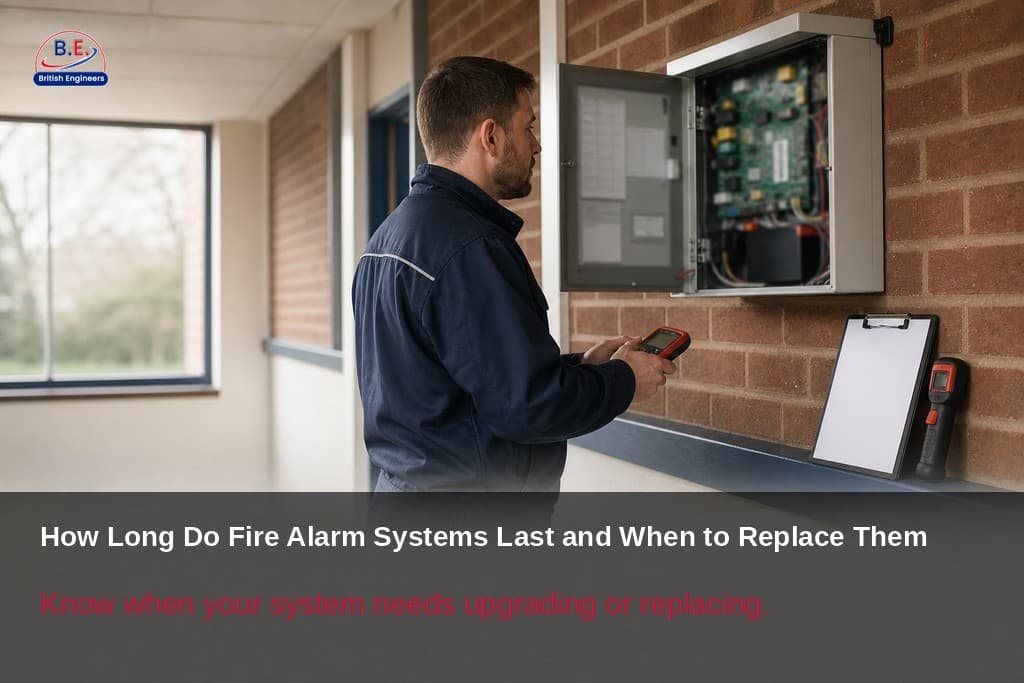
Table of contents
Understanding fire alarm system lifespan is one of the most practical steps any homeowner or property manager can take to protect lives and maintain legal compliance. It is also one of the most misunderstood areas of fire safety, largely because people treat the system as a single unit rather than a collection of components, each with its own service life. Whether you manage a commercial premises in Manchester city centre or own a family home in areas such as Salford, Stockport, or Trafford, knowing when your system needs attention and why gives you a significant safety advantage.
This article explains what genuinely determines how long fire alarms last, which components wear out first, and how to make informed decisions about fire alarm upgrades and replacements before a fault puts your property at risk.
How Long Does a Fire Alarm System Last?
A fire alarm system does not have a single expiry date. Different components age at different rates, so the lifespan of your system depends on what it contains, where it is installed, and how well it has been maintained.
The ten-year figure you may have heard applies most accurately to individual smoke detectors. It describes a statistical threshold rather than a fixed expiry date. What actually determines overall life expectancy is a combination of component type, installation environment, maintenance history, and whether the system still meets current British Standards, particularly BS 5839, which governs fire detection and alarm systems in UK buildings.
When these variables are ignored, property owners either replace systems too early and waste money, or hold onto ageing equipment long past the point where it can be trusted. A properly informed approach considers each factor individually and treats the system as a collection of parts rather than a single product with one expiry date.
Fire Alarm Lifespan by Component Type
The most accurate way to plan maintenance and replacement is to look at each component separately. A typical fire alarm system includes smoke detectors, heat detectors, carbon monoxide detectors, sounders, manual call points, and a central control panel. Each has a different working life, and replacing everything on the same schedule rarely makes practical sense.
Typical component lifespans based on industry guidance are as follows:
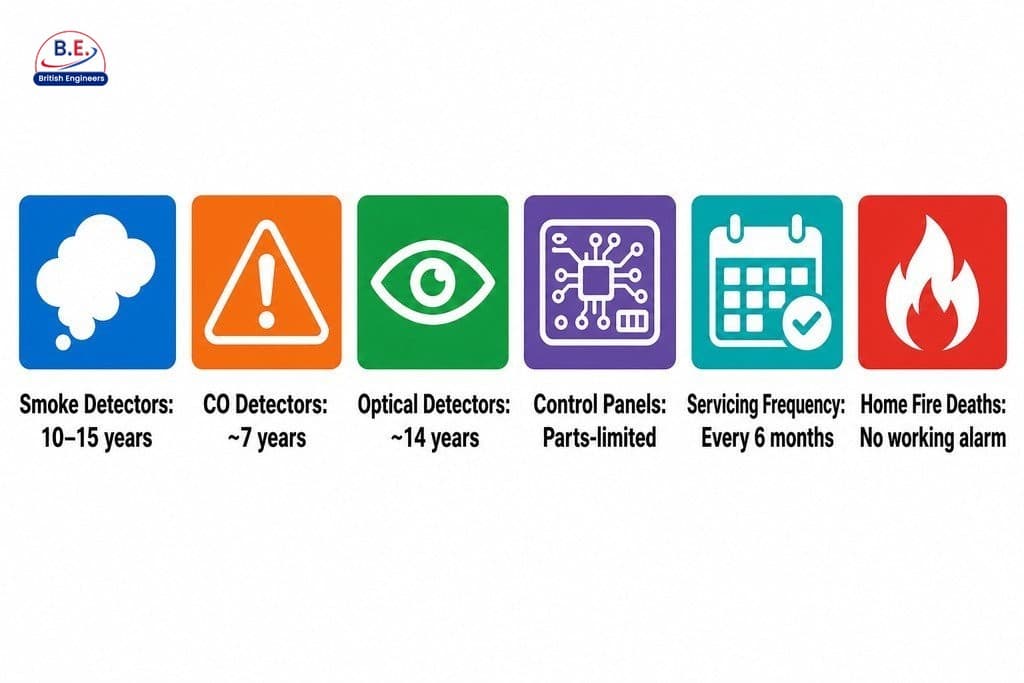
- Smoke detectors: approximately 10 years (domestic); up to 15 years (commercial)
- Optical fire detectors: approximately 14 years
- Carbon monoxide detectors: approximately 7 years
- Heat detectors and manual call points: generally longer, due to simpler mechanics
- Control panels: variable, often limited by software support and parts availability rather than physical failure
| Component | Typical Lifespan | Key Replacement Trigger |
|---|---|---|
| Smoke detectors (domestic) | Approx. 10 years from manufacture date | Age threshold or sensor drift |
| Smoke detectors (commercial) | Up to 15 years | Age threshold or compliance review |
| Optical fire detectors | Approx. 14 years | Sensor degradation or manufacturer guidance |
| Carbon monoxide detectors | Approx. 7 years | Electrochemical cell expiry |
| Heat detectors & manual call points | Generally longer than detectors | Physical damage or compliance change |
| Control panels | Variable | Parts unavailability or software obsolescence |
When Should Smoke Detectors Be Replaced?
The Fire Industry Association (FIA) recommends replacing domestic smoke detectors after 10 years and commercially installed detectors after 15 years, unless the manufacturer specifies an earlier date. Commercial-grade units are typically built to higher tolerances and maintained more regularly, which supports a longer service life.
One important detail: the 10-year period runs from the manufacture date printed on the unit, not from when it was installed. A detector that sat in a storeroom for two years before being fitted is already two years into its service life before it is ever switched on.
It is also worth understanding the difference between age-based and failure-based replacement. A detector may still pass a weekly test but perform poorly in real conditions due to sensor drift. Research cited by the National Fire Protection Association (NFPA), drawing on an Ontario Housing Corporation study, found that approximately 3% of smoke alarms fail within one year, and that by the 30-year mark nearly all will have failed. Replacing at 10 years, when failure probability reaches roughly 30%, represents a sound balance between safety and cost.
When Does a Fire Alarm Control Panel Need Replacing?
The control panel is often the most overlooked component. Panels rarely fail suddenly. They tend to degrade gradually through software obsolescence, discontinued firmware support, and the unavailability of spare parts. A panel may still function in isolation while being incompatible with newer detectors or communication protocols required under current BS 5839 standards.
In many cases, a panel needs replacing not because it has broken down, but because it can no longer support the components required for compliance. Engineers will also consider whether repair is cost-effective or whether the labour and parts cost would exceed the value of a full replacement.
Does Property Type Affect How Long a Fire Alarm Lasts?
Yes, significantly. Residential and commercial environments place very different demands on fire alarm components.
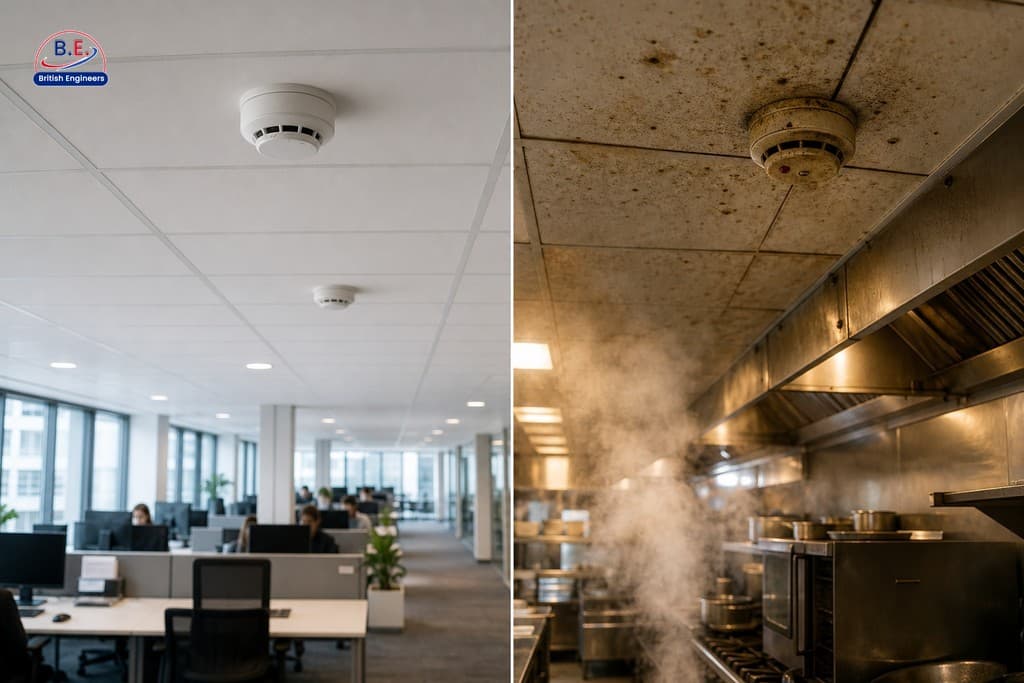
In a domestic property with stable temperatures, low dust levels, and moderate occupancy, components are likely to remain reliable throughout their rated service lives, provided they are maintained correctly. In commercial environments, particularly those involving cooking, manufacturing, or high footfall, components face elevated levels of particulate matter, humidity, and temperature fluctuation. These conditions accelerate sensor drift and can shorten component life considerably.
This is a particularly relevant consideration across Greater Manchester, where the range of property types is broad. From converted industrial units and busy restaurant quarters in the Northern Quarter to large multi-occupancy residential developments in Ancoats or Salford Quays, each setting places its own demands on fire alarm equipment. Dust and moisture are among the most damaging factors, as they interfere directly with optical and chemical sensors inside detectors. A system that would comfortably reach its rated lifespan in a dry office may need more frequent servicing, or earlier replacement, in a harsher setting.
| Property Type | Typical Environment | Impact on Component Lifespan | Servicing Frequency |
|---|---|---|---|
| Domestic (standard) | Stable temperature, low dust | Components tend to reach rated lifespan | Annual inspection recommended |
| Commercial office | Moderate occupancy, low particulates | Generally reaches rated lifespan with routine maintenance | At least every six months (BS 5839) |
| Commercial kitchen / restaurant | High heat, cooking fumes, moisture | Accelerated sensor drift; may need earlier replacement | Quarterly or more frequent |
| Industrial / warehouse | Dust, temperature fluctuation | Reduced lifespan likely; closer monitoring needed | Quarterly or per risk assessment |
| Multi-occupancy residential | Varied use, higher footfall | Depends on individual zones and usage | At least every six months (BS 5839) |
Warning Signs Your Fire Alarm System Needs Attention
Age alone should not be the only reason to review your system. There are several practical signs your fire alarm system needs upgrading, and waiting for a scheduled replacement date can create a false sense of security.
Watch out for these indicators:
- Frequent false alarms: a clear sign that detectors are ageing or drifting out of calibration. Research from the US Consumer Product Safety Commission (CPSC) found that over one-third of disabled smoke alarms were disconnected by occupants due to nuisance alarms, removing all protection entirely.
- Slow or inconsistent responses during routine tests
- Visible physical damage or discolouration on detectors or devices
- Difficulty sourcing replacement parts for your existing panel or components
- Intermittent faults that resolve themselves, as these often indicate internal degradation that will worsen over time
If your maintenance provider advises that components for your current system are no longer manufactured or supported, that is a strong signal to act promptly.
How Maintenance and Servicing Affects System Lifespan
Routine servicing plays a significant role in extending fire alarm system lifespan and keeping your installation compliant with insurance and regulatory requirements.
For domestic properties, this typically means:
- Weekly testing of sounders
- Monthly testing of detectors
- An annual inspection
For commercial properties, BS 5839 requires more structured servicing, often quarterly inspections by a qualified engineer. As the FIA notes, equipment manufacturers are the best guide to expected product lifetime, which means servicing alone cannot substitute for following manufacturer-recommended replacement cycles.
One distinction worth understanding: pressing the test button on a detector confirms that the sounder and circuit are working, but it does not assess the sensitivity of the detection chamber itself. A detector can pass a button test and still fail to respond adequately to actual smoke. For commercial properties, complex multi-floor installations, or any system covering multiple zones, a certified engineer should carry out formal commissioning checks and sensitivity testing.
According to the National Fire Protection Association, nearly two-thirds of home fire deaths occur in properties with no working smoke alarms, which underscores why regular, thorough servicing matters beyond basic functionality checks.
How British Engineers Approaches Fire Alarm Assessments in Manchester
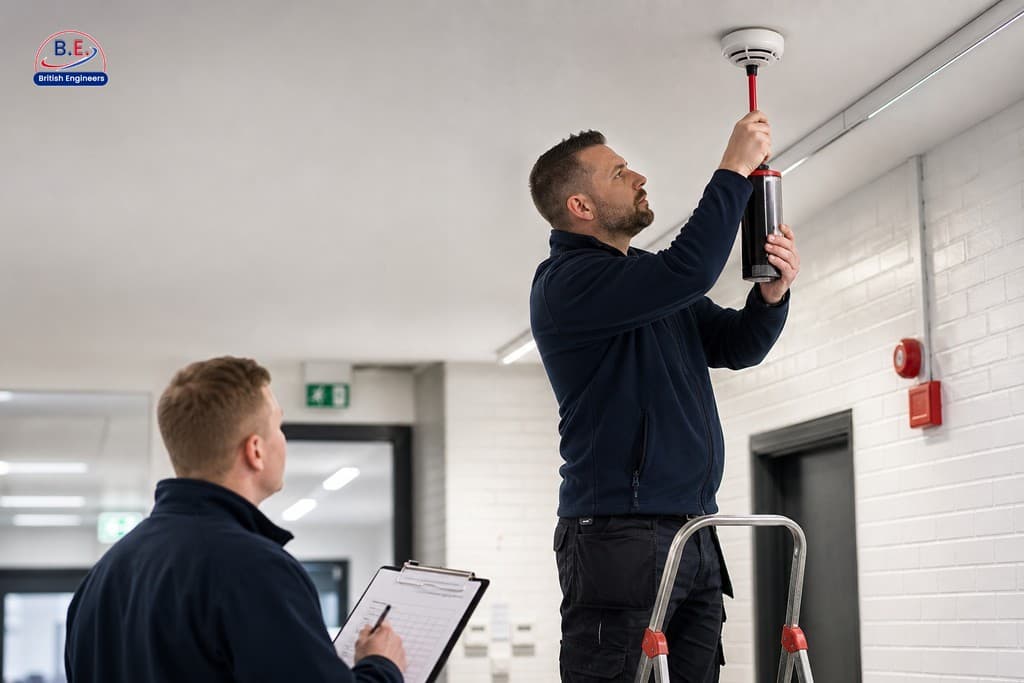
At British Engineers, we do not arrive at a property with a predetermined replacement recommendation. Our certified engineers carry out a thorough assessment of your existing system, looking at the age and condition of individual components, the installation environment, current BS 5839 compliance, and whether the system still suits how the property is now used.
A property that has been extended, converted, or changed in occupancy since the original installation may need a system redesign rather than a straightforward like-for-like replacement. This is something we encounter regularly across Manchester and the wider Greater Manchester region, where older terraced housing, converted commercial buildings, and newer high-density developments each present their own fire safety considerations. We use high-quality materials and reliable technology in all our installations, and we are transparent about what needs replacing now versus what can be maintained through servicing for a further period.
Our long-term support means we remain available after installation for maintenance, inspections, and repairs, so you are never left managing a complex system without professional guidance. For homeowners and property managers across Manchester, Salford, Stockport, Trafford, and the wider region, our approach is built around your actual circumstances rather than a generic schedule.
What to Check Before Replacing or Upgrading Your Fire Alarm System
Before committing to any replacement or upgrade, gather key information so you can make the right decision for your property. Going into a conversation with a fire alarm engineer already informed leads to better outcomes.
- Check whether your current system complies with BS 5839 for your property type and occupancy
- Confirm the manufacture date on each detector to establish where components sit in their service life
- Ask your engineer whether replacement parts and firmware updates are still available for your current panel
- Review your warranty status and confirm whether any components are still covered
- Consider whether the system layout still reflects how the property is used today, particularly if rooms have changed purpose or new areas have been added
Taking these steps before any conversation about fire alarm upgrades and replacements means you go in with a clearer picture of what your system actually needs. British Engineers is here to help you work through this process, from initial assessment to full installation and ongoing support. Contact our team today to arrange a professional fire alarm evaluation for your Manchester property.
Frequently Asked Questions About Fire Alarm System Lifespan
How long does a fire alarm system last in a UK home?
Most domestic smoke detectors should be replaced after 10 years from their manufacture date. Carbon monoxide detectors typically need replacing after around 7 years, while heat detectors and manual call points may last longer. The system as a whole does not have a single expiry date, as each component ages at a different rate.
Does BS 5839 specify when fire alarm systems must be replaced?
BS 5839 does not set a fixed replacement date for entire systems, but it requires that systems remain fit for purpose and properly maintained. If components are obsolete, unsupported, or no longer compliant with current standards, replacement becomes necessary to satisfy BS 5839 requirements.
Can a fire alarm detector fail even if it passes the test button check?
Yes. The test button confirms the sounder and circuit are functional, but it does not measure detection chamber sensitivity. A detector affected by sensor drift may pass a button test yet fail to respond adequately to actual smoke. Sensitivity testing by a qualified engineer is the only reliable way to assess this.
How often should commercial fire alarm systems be serviced in the UK?
BS 5839 generally requires commercial fire alarm systems to be inspected by a qualified engineer at least every six months, with many installations requiring quarterly visits depending on complexity and occupancy. Regular servicing helps extend component lifespan and ensures ongoing compliance.
What happens if fire alarm components are no longer available for my existing panel?
When spare parts or firmware updates are no longer available for a control panel, the system cannot be properly maintained or brought into compliance with current standards. Full panel replacement is typically the most practical and cost-effective course of action in this situation.
Does the environment affect how quickly fire alarm detectors wear out?
Yes. High dust, moisture, cooking fumes, or significant temperature fluctuation accelerate sensor drift and reduce component lifespan. Detectors in commercial kitchens, warehouses, or industrial spaces may need earlier replacement or more frequent servicing than those in a standard office or domestic setting.