Key Takeaways
A fire alarm maintenance checklist is a practical, life-saving routine that goes far beyond compliance, covering weekly tests, detector care, and professional servicing.
- Weekly manual call point tests and monthly panel reviews form the foundation of any reliable alarm upkeep checklist, helping catch faults before they become failures.
- Detector cleaning and checks are among the most overlooked maintenance tasks; dust and debris build up inside sensing chambers can cause both missed alarms and false alerts.
- Fire panel maintenance tips include reading the fault log regularly and checking zone displays, but any persistent fault or component replacement requires a certified engineer.
- Businesses in the UK must keep a formal logbook of every test, fault, and engineer visit as a legal and insurance requirement under BS 5839 and the Regulatory Reform (Fire Safety) Order 2005.
- Preventive maintenance programmes can reduce fire alarm costs by 12 to 18 percent annually compared to reactive repair, making routine professional servicing a sound investment for any property.
A fire alarm maintenance checklist is more than a sheet of boxes to tick before an inspector arrives. It is the practical backbone of a system that could save lives on an ordinary Tuesday afternoon when no one expects anything to go wrong. For homeowners and property managers across Manchester, whether you manage a terraced house in Didsbury, a commercial unit in Salford, or a multi-occupancy building in the city centre, understanding what each item on that checklist actually means is the difference between a system that works when it counts and one that fails silently over time.
This guide walks through the full scope of fire alarm upkeep in plain terms, drawing on UK standards and real-world consequences. Whether you manage a single home or a multi-occupancy commercial building, the same principle applies: maintenance is not a formality. It is fire safety made practical.
Why Routine Fire Alarm Maintenance Goes Beyond Compliance
Many property owners treat fire alarm servicing as a regulatory hurdle rather than a genuine safety measure. That mindset creates a gap between what looks compliant on paper and what is actually ready in an emergency.
UK businesses are legally required to maintain fire alarm systems under the Regulatory Reform (Fire Safety) Order 2005 and BS 5839, the British Standard for fire detection and alarm systems. But compliance and readiness are not always the same thing.
The numbers behind poor maintenance are sobering. According to UK Fire and Rescue Services, over 30% of commercial fire alarms fail during inspections due to poor maintenance. More than 22,000 non-dwelling building fires occurred over two years, with approximately 3,700 occurring because an alarm failed to sound. Each of those failures had a maintenance story behind it.
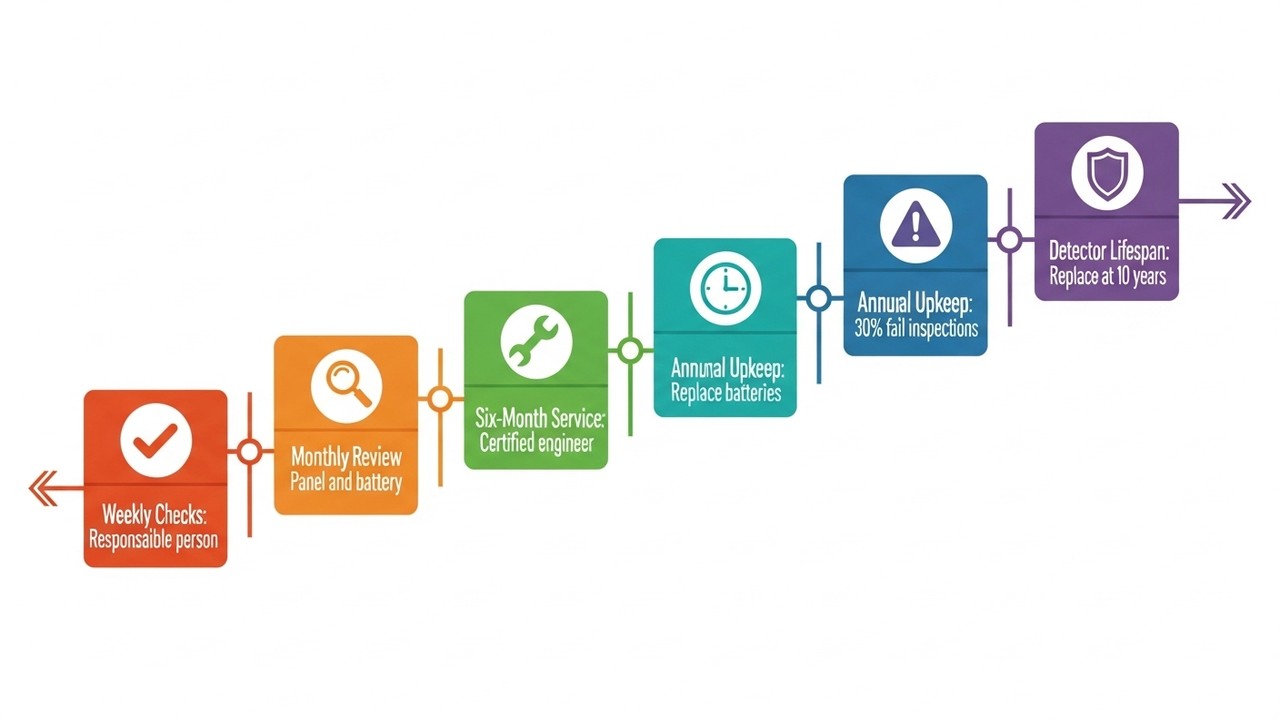
BS 5839 sets clear expectations: weekly tests carried out by the responsible person, and full professional servicing every six months. These are not arbitrary intervals. They reflect how fire alarm components age, how environments change, and how small faults compound into full system failures. Treating your checklist as a fire alarm compliance guide, rather than just a legal obligation, shifts the entire mindset from reactive to genuinely protective.
Your Fire Alarm Maintenance Checklist, Step by Step
A well-structured maintenance routine covers three time horizons: weekly, monthly, and annual. Each layer of the fire alarm testing checklist serves a different purpose, and skipping any one of them leaves gaps that only become visible at the worst possible moment.
Weekly Fire Alarm Checks
Weekly checks are the first line of defence and can be carried out by the responsible person at the property without specialist tools or training. The key task is activating a manual call point using the test key to confirm the alarm sounds across all zones. Each week, rotate to a different call point so the full system is cycled through over time. After the test, the control panel should return to its normal status with no residual fault indicators remaining.
Monthly Alarm Inspections
Monthly checks build on the weekly foundation. During a monthly inspection, review indicator lights on the panel to confirm all zones show a clear status, check for battery condition warnings and communication faults, and review any logged alerts from the previous weeks. A normal result means a clear panel display, a sounding alarm on activation, and a system that resets cleanly. If any of those three outcomes does not occur as expected, the system needs closer attention.
| Check Frequency | Who Carries It Out | Key Tasks | Expected Outcome |
|---|---|---|---|
| Weekly | Responsible person | Activate manual call point with test key; rotate call points over time | Alarm sounds across all zones; panel returns to normal with no fault indicators |
| Monthly | Responsible person | Review panel indicator lights; check battery and communication warnings; review logged alerts | Clear panel display; alarm sounds on activation; system resets cleanly |
| Every 6 months | Certified engineer | Full system function test; detector condition assessment; panel health checks; fault history review | Compliance with BS 5839; all faults identified and documented |
| Annually | Certified engineer (plus responsible person for batteries) | Battery replacement in standalone alarms; full professional service for residential properties | Batteries replaced; system confirmed operational; service record updated |
Fire Panel Maintenance: What Property Managers Should Monitor
The control panel is the central intelligence of the entire system. It receives signals from every detector, call point, and sounder, and it is the first place that shows when something is wrong.
One of the most useful fire panel maintenance practices is to read the fault log regularly rather than waiting for an audible warning. Panels often record low-level faults, zone isolation events, and battery alerts well before they escalate into obvious problems. Property managers should check zone displays to confirm all areas are active and unsilenced, and review battery backup health, which many panels display directly on screen.
Anything beyond reading and logging those displays requires a certified engineer. Resetting persistent faults, replacing internal components, reconfiguring zone maps, and carrying out formal commissioning checks must all be handled by a qualified professional.
Detector Cleaning and Checks That Are Commonly Overlooked
A detector that has never triggered is not necessarily a reliable one. Over time, optical detectors accumulate dust, grease particles, and even insects inside their sensing chambers. This build-up can desensitise a detector, causing it to respond too slowly to real smoke, or trigger false alarms from environmental interference. In older commercial properties and converted buildings, which are common across Greater Manchester, this kind of gradual degradation is particularly worth monitoring.
How to Clean Fire Alarm Detectors Safely
Optical detectors can be gently vacuumed around their outer vents using a soft brush attachment. Internal cleaning should only be performed by an engineer with appropriate equipment. Heat detectors are generally more robust but should still be visually inspected for physical damage, corrosion, or obstruction.
Batteries in smoke alarms should be replaced annually, and the entire unit replaced every ten years. According to TSW Training, around 90 people lose their lives every year in the UK due to issues with smoke alarm batteries. The cost of a replacement battery is negligible compared to what that simple check protects.
Maintenance Requirements by Property Type in Manchester
A domestic property with a simple interlinked alarm system has a very different maintenance profile from a commercial building running a fully addressable fire alarm panel. Manchester’s mix of Victorian terraces, modern apartment blocks, and large commercial premises means maintenance needs vary considerably from one building to the next.
Homeowners
For homeowners, the maintenance routine is relatively straightforward: weekly test button activations, annual battery replacement, regular vacuuming around detector heads, and a professional service visit every twelve months at minimum. Keeping a simple log of each check, even a handwritten note with the date and outcome, builds the record that insurers and landlords increasingly expect to see.
Commercial and Multi-Occupancy Buildings
For multi-occupancy buildings, commercial premises, and properties with complex zoned systems, the requirements are more structured. A formal logbook is a legal and insurance requirement for businesses in the UK. Every test, fault, engineer visit, and remedial action must be captured. Properties with suppression systems, aspirating detectors, or integrated emergency lighting require a more detailed fire detection maintenance approach than a standard checklist can provide. The responsible person must understand not just what to check, but how each part of the system interconnects and where a fault in one zone can affect coverage elsewhere.
| Property Type | Typical System | Logbook Required | Professional Service Frequency | Key Maintenance Considerations |
|---|---|---|---|---|
| Homeowner (domestic) | Interlinked standalone alarms | Recommended but not legally required | Annually | Weekly tests; annual battery replacement; detector vacuuming; unit replacement every ten years |
| Commercial premises | Addressable or conventional panel system | Yes, legal and insurance requirement | Every six months | Formal logbook; zone fault monitoring; certified engineer for all fault work and commissioning |
| Multi-occupancy building | Zoned or fully addressable system | Yes, legal and insurance requirement | Every six months | Interconnected zone awareness; suppression or aspirating systems may require additional checks |

When to Call a Certified Fire Alarm Engineer
Self-inspection has clear limits, and recognising those limits is part of responsible property management. A certified engineer should be contacted when the control panel displays a persistent fault that does not clear after following the manufacturer’s reset procedure, when a detector flags repeatedly in a zone with no obvious environmental cause, when the system fails to sound during a weekly test, or when a battery backup warning appears outside of a scheduled maintenance window.
Fire protection research cited via osapiens CMMS suggests that facilities implementing preventive maintenance programmes may achieve meaningful cost reductions compared to reactive approaches. Catching a fault during a routine professional visit typically costs significantly less than emergency repair after a failure. Full system commissioning checks, compliance certification, zone reconfiguration, and component replacement can only be completed by a qualified engineer, and no checklist substitutes for that level of professional oversight.
How British Engineers Supports Fire Safety Across Manchester
At British Engineers, our approach to fire alarm maintenance is built around certified expertise, transparent pricing, and support that continues long after the initial work is done. When one of our engineers visits your property for a maintenance inspection, the visit covers a full system function test, control panel health checks, detector condition assessments, battery and power supply verification, and a review of any fault history logged since the previous visit. Nothing is glossed over, and you receive a clear account of what was found and what was done.
We work with homeowners and property managers throughout Manchester and the surrounding areas, including Salford, Stockport, Trafford, and Oldham. The question of how often fire alarms should be serviced deserves a straight answer, not a vague recommendation, and that is exactly what our team provides from the first consultation, along with a transparent quotation that covers exactly what your system needs.
We do not believe in one-size-fits-all servicing, because no two properties carry the same risk profile or system configuration. If you would like to discuss your current fire alarm setup or arrange a professional inspection anywhere in Greater Manchester, our team is ready to help you build a maintenance routine that genuinely protects your property.
Frequently Asked Questions About Fire Alarm Maintenance
How often should a fire alarm system be professionally serviced?
Under BS 5839, most commercial fire alarm systems should be professionally serviced every six months. Residential properties should have at least one professional service visit per year. The appropriate frequency can depend on your system type, building use, and risk level, so your engineer can confirm the right schedule for your setup.
Can the responsible person carry out fire alarm checks without being a qualified engineer?
Yes. Weekly manual call point tests and basic monthly panel checks can be carried out by the designated responsible person without specialist training. Fault investigation, component replacement, zone reconfiguration, and formal compliance certification must always be handled by a qualified fire alarm engineer.
What should I do if my fire alarm panel shows a fault?
Check the panel display to identify the fault type and zone. Follow the manufacturer’s reset procedure as a first step. If the fault persists or reappears, contact a certified engineer promptly. Do not silence or disable the panel as a workaround, as this can leave areas of your building without detection coverage.
How long do smoke alarm detectors last before they need replacing?
Most smoke alarm units have a recommended service life of ten years. After this point, the sensing chamber degrades and reliability decreases, even if the unit appears to function. Batteries in standalone alarms should be replaced annually. Addressable detectors in commercial systems are assessed individually during professional servicing.
Is a fire alarm maintenance logbook legally required?
For commercial and multi-occupancy properties in the UK, a fire alarm logbook is a legal and insurance requirement under the Regulatory Reform (Fire Safety) Order 2005. It must record all tests, faults, engineer visits, and remedial actions. Homeowners are not legally required to keep one, but doing so is strongly recommended for insurance and landlord purposes.
What happens if a fire alarm system fails during an inspection?
A failed inspection typically results in a formal notice requiring remedial work within a specified timeframe. In commercial settings, this can affect insurance coverage and legal compliance status. Persistent failure to maintain an adequate system may lead to enforcement action by the local fire authority.