Key Takeaways
British Engineers guides Manchester business owners through access control security and compliance planning to protect staff, assets, and legal standing from day one.
- Start with a building entry risk assessment before choosing any hardware. Walk your premises, identify every entry point, and categorise each zone by sensitivity to allocate the right level of technology and monitoring where it matters most.
- Access control compliance planning is a legal obligation under GDPR. Any system that records who entered your building and when is processing personal data, so audit logs must be stored securely, retained appropriately, and accessible only to authorised personnel.
- A documented controlled entry policy is just as important as the hardware. Without clear rules for granting, reviewing, and revoking permissions, even advanced systems can develop serious compliance gaps when staff leave or contractor access is never removed.
- Role Based Access Control is a practical and scalable approach for businesses of any size. Tying permissions to job function rather than individual identity simplifies auditing and makes it straightforward to update access when roles change.
- Installation by certified engineers is essential for compliance grade performance. Incorrect installation can void warranties, introduce vulnerabilities, and prevent your system from producing the audit trails your obligations require.
For business owners managing commercial premises in Manchester and across the wider region, access control security and compliance planning is no longer a secondary consideration. It sits at the centre of how you protect your staff, your assets, and your legal standing. Whether you operate a small office, a warehouse, or a multi-site operation, the way you manage who enters your building and when carries real consequences for your day-to-day risk exposure. Getting that planning right from the start is what separates businesses that react to incidents from those that prevent them.
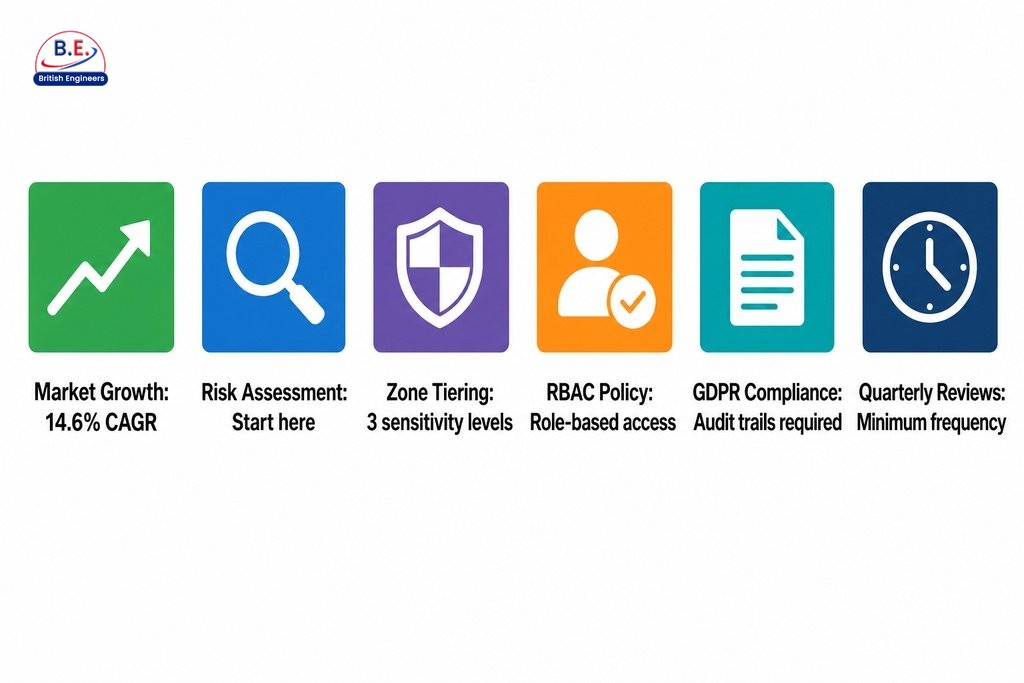
The demand for structured access governance is rising sharply. According to The Business Research Company, the global access control market is projected to grow from $14.96 billion in 2025 to $17.15 billion in 2026 at a compound annual growth rate of 14.6%. That level of investment reflects a broader shift in how seriously organisations now treat entry management, not just as a physical security measure but as a compliance obligation. This article walks you through the core elements of building a secure, compliant access plan for your business premises.
What Is Access Control Security and Compliance Planning?
Access control security and compliance planning is the process of deciding who can enter which areas of your premises, under what conditions, and how that activity is recorded and reviewed. It combines physical security measures such as electronic locks, card readers, and biometric systems with documented policies that define permissions, audit trails, and review cycles. The goal is to protect people and assets while demonstrating to regulators, insurers, and auditors that your entry management meets the standards required of your industry.

Why It Matters for Manchester Businesses
Poor access management creates vulnerabilities that extend well beyond an unlocked door. When the wrong person enters a restricted area, the consequences can include theft, data exposure, liability claims, and regulatory penalties. UK businesses are operating under a compliance environment that links physical access directly to data protection law. Under GDPR, organisations are required to implement strict identity verification, access restrictions, and audit trails to safeguard sensitive information. If your entry system cannot show who accessed what and when, you may already be falling short of those obligations.
As noted in research published by ScienceDirect in the Cyber Security and Privacy journal, “Access Control is a crucial defense mechanism organizations can deploy to meet modern cybersecurity needs and legal compliance with data privacy. The aim is to prevent unauthorized users and systems from accessing protected resources in a way that exceeds their permissions.” This principle applies just as directly to physical doors and barriers as it does to digital systems. Thinking about access control security risks as a unified concern, rather than separating physical and digital threats, is the approach that keeps businesses protected across the board.
When treated as a practical layer of protection rather than a box-ticking exercise, secure access planning strengthens operational resilience, builds staff confidence, and demonstrates due diligence to insurers, auditors, and clients alike.
How to Start: Building an Entry Risk Assessment
Every effective secure access plan begins with a clear picture of your premises. Before choosing any hardware or software, you need to understand where the actual risks are concentrated. Sound building entry risk management does not require specialist technical knowledge at this stage. It requires honest answers to straightforward questions about your operations.
Walk your premises with a critical eye. Note every entry point, from main doors and loading bays to internal corridors and server rooms. Consider the times of day when each area is occupied and when it is left unattended, and think about contractors, cleaning staff, and visitors alongside your regular team. The ProtectUK platform, backed by UK policing, recommends conducting this kind of operational requirements review before any installation begins, precisely because the planning stage determines how well the finished system performs in practice.
As you review each area, focus on four core questions: Which areas contain sensitive data or high-value assets? Who legitimately needs to be in those areas? How often are those areas accessed? And what would happen if an unauthorised person entered? Those answers will shape every decision that follows.
How to Categorise Entry Points by Sensitivity
Not every door in your building carries the same level of risk. A practical three-tier framework helps allocate the right level of resource and technology to each zone, without over-engineering low-risk areas or under-protecting the ones that matter most.
General access areas such as reception zones, break rooms, and open-plan offices require basic monitoring and audit trail capability. Restricted zones such as management offices, stock rooms, and areas with sensitive client data require controlled entry with logged permissions. High-security locations such as server rooms, cash handling areas, and pharmaceutical storage require the strongest authentication methods and the most rigorous review cycles.
| Zone Tier | Example Areas | Monitoring Level | Authentication Requirement | Audit Trail Priority |
|---|---|---|---|---|
| General Access | Reception, break rooms, open-plan offices | Basic | Low (standard key or fob) | Standard logging |
| Restricted Zone | Management offices, stock rooms, client data areas | Controlled | Medium (fob with logged permissions) | Detailed logging with regular review |
| High-Security Location | Server rooms, cash handling areas, pharmaceutical storage | Stringent | High (biometric or multi-factor) | Rigorous, frequent review cycles |

What Are the Core Access Control Compliance Requirements?
Understanding access control compliance requirements is essential before you commit to any particular system. At a minimum, your access control infrastructure should record entry events accurately, including who accessed which area, at what time, and through which credential. It should also retain those records in line with data protection obligations and allow you to demonstrate to regulators or auditors that permissions are granted and revoked appropriately.
Certain industries carry stricter obligations than others. Healthcare providers, financial services firms, and businesses handling personal data at scale face heightened expectations around physical access governance. Research published via ResearchGate, drawing on 223 participants across 56 organisations, found measurable variation in how organisations implement and manage access control security measures when assessed against the ISO/IEC 27002 standard. That variation highlights how easily compliance gaps can develop, even in businesses that believe they have the basics covered.
Role-Based Access Control (RBAC) is consistently identified as one of the more manageable approaches for businesses because it ties permissions directly to job function rather than to individuals, making it easier to audit and adjust as your team changes.
How to Build a Controlled Entry Policy That Works in Practice
Hardware alone does not create a compliant access environment. A well-designed access control policy for businesses gives the technology its structure and purpose. Your policy should clearly document who is responsible for granting and revoking access permissions, how often those permissions are reviewed, and the exact process when a staff member leaves or changes role.
Without those answers documented and communicated, even a sophisticated system can develop gaps. Common policy failures include permissions that are never revoked after an employee departs, contractor access that is granted temporarily but never removed, and shared credentials that make audit trails meaningless. According to research from ASIS International, organisations are actively shifting away from low-security legacy technologies, with compliance and risk management identified as the primary drivers of that change. A strong policy closes the gap between what your system is capable of recording and what your business actually does with that information.
Which Entry Technology Is Right for Your Policy?
Different entry technologies serve different policy needs. Fob-based systems are straightforward to manage and easy to revoke, making them well-suited to general staff access across multiple entry points. PIN-based systems are flexible but carry a higher risk of credential sharing, which can undermine your audit trail. Biometric systems using fingerprint or facial recognition provide strong individual authentication and are particularly relevant for high-security zones where precise access accountability is a priority. The right choice depends on the sensitivity of the zone, the volume of users, and the level of auditability your compliance obligations require.
| Technology | Ease of Management | Credential Sharing Risk | Authentication Strength | Best Suited For |
|---|---|---|---|---|
| Fob-Based | High — easy to issue and revoke | Low to medium | Medium | General staff access across multiple entry points |
| PIN-Based | High — flexible setup | Higher — codes can be shared | Low to medium | Low-sensitivity areas where convenience is prioritised |
| Biometric (fingerprint/facial) | Medium — requires enrolment process | Very low — tied to individual | High | High-security zones requiring precise access accountability |

When Should You Bring in Certified Engineers?
Identifying risk areas and drafting a policy framework is something most business owners can do independently. However, the physical installation, system configuration, and compliance-grade commissioning of an access control systems installation manchester requires qualified engineers. Incorrect installation can introduce vulnerabilities, void warranties, and leave you with a system that cannot produce the audit trails your compliance obligations demand.
Before engaging any installer in the Manchester area, confirm that the engineers hold recognised industry qualifications, that the company carries appropriate insurance, which hardware brands and materials they use, and whether post-installation support is available. At British Engineers, every installation is carried out by certified professionals using quality-grade technology, and we provide ongoing support arrangements to help ensure your system continues to perform and remain compliant as your business evolves. A transparent quotation with no hidden costs should be a baseline expectation from any credible provider.
What Ongoing Secure Access Planning Looks Like After Installation
Installation is the beginning of your access control journey, not the end. A system that is not reviewed and maintained will drift out of alignment with your compliance obligations and your operational reality. Your review cycle should confirm that access permissions still reflect current staff roles and contractor arrangements, that audit logs are being captured, retained, and reviewed correctly, and that readers, locks, and credentials are functioning as intended.
Long-term support arrangements also matter when it comes to integrating access control with cctv and other security systems across your premises. As your security infrastructure grows, the relationship between entry management, video monitoring, and alarm response becomes increasingly important for both operational efficiency and audit readiness. Access control software is projected to grow at an 8.78% CAGR to 2031, according to Mordor Intelligence, with predictive analytics and AI-driven anomaly detection being incorporated into management platforms. Businesses that build their systems with future-readiness in mind and maintain a support relationship with their installer are generally better positioned to take advantage of those capabilities as they become more widely available.
If you are ready to build a secure access plan that keeps your Manchester business protected and compliant, the team at British Engineers is here to help. Contact us today for a personalised consultation and a transparent quotation with no surprises.
Frequently Asked Questions Related to Access Control Security and Compliance Planning
What is the difference between physical and logical access control?
Physical access control governs who can enter buildings, rooms, or areas using hardware such as locks, card readers, and biometric scanners. Logical access control manages who can access digital systems, files, or networks. Treating both as part of a unified security strategy, rather than separate concerns, is considered best practice for compliance.
How often should a business review its access permissions?
Access permissions should be reviewed at least quarterly, and immediately whenever a staff member leaves, changes role, or a contractor engagement ends. Regular reviews prevent the accumulation of outdated permissions, which is one of the most common causes of compliance gaps found in access control audits.
Does GDPR apply to physical access control systems?
Yes. Under GDPR, any system that records who entered a building and when is processing personal data. Businesses must ensure audit logs are stored securely, retained only as long as necessary, and accessible only to authorised personnel. Failing to manage this correctly can result in regulatory penalties.
What qualifications should I look for in an access control installer?
Look for engineers with recognised industry certifications relevant to electronic security systems. The company should also carry appropriate professional liability insurance. Asking for references and confirming post-installation support availability before signing any agreement is strongly advisable.
Can a small business benefit from Role-Based Access Control (RBAC)?
Yes. RBAC is scalable and works effectively for small teams. By assigning permissions based on job function rather than individual identity, it simplifies auditing and makes it straightforward to update access when staff roles change, making it a practical option for businesses of any size.