Key Takeaways
UK building owners must understand fire alarm regulations, legal duties, and testing obligations to stay compliant, protect occupants, and avoid serious penalties.
- Under the Regulatory Reform (Fire Safety) Order 2005, every non-domestic premises must have a designated responsible person who is legally accountable for fire risk assessments and maintaining appropriate fire detection measures.
- BS 5839-1 is the principal British Standard for fire detection and alarm systems in non-domestic premises and is widely recognised by enforcement authorities as the benchmark for compliance.
- Commercial premises should carry out weekly manual call point tests and arrange formal engineer servicing at least twice a year, with all records kept available for inspection.
- Landlords and property managers face building fire detection obligations under the Fire Safety (England) Regulations 2022, requiring regular checks and record keeping for communal fire detection equipment.
- New installations, system upgrades, fault investigations, and building layout changes all require a qualified fire alarm engineer to avoid coverage gaps, insurance issues, and personal liability.
Understanding fire alarm regulations is one of the most important responsibilities any building owner or property manager can take on. Whether you own a commercial premises in Manchester city centre, manage a residential block in Salford, or rent out property to tenants across Greater Manchester, the legal framework surrounding fire detection is detailed, far-reaching, and non-negotiable. This fire alarm compliance guide is designed to cut through the complexity and give you a clear picture of what the law requires, what best practice looks like, and where professional support becomes essential.
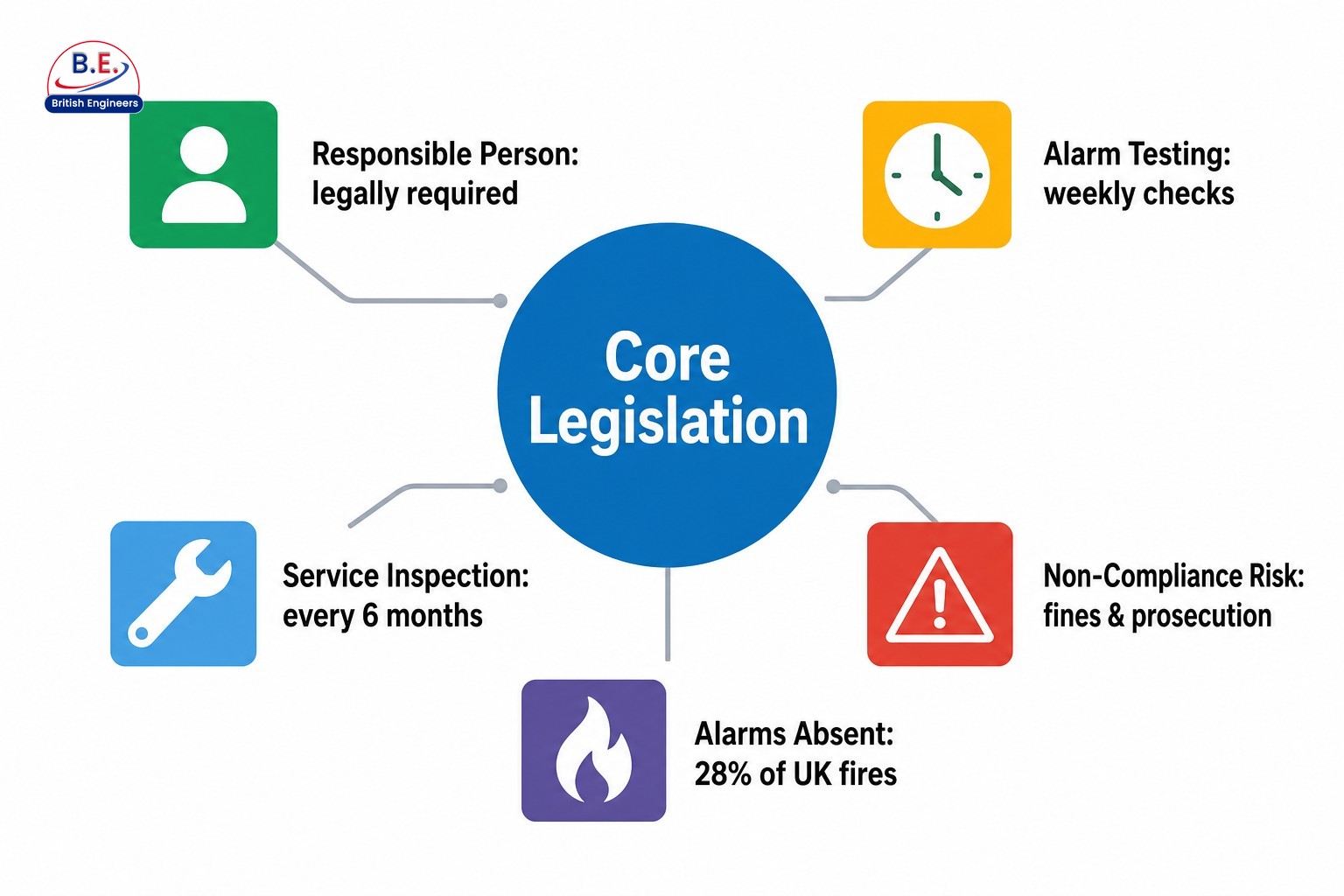
Fire alarm regulations in the UK are not simply a bureaucratic checklist. They exist because the human consequences of inadequate fire detection are genuinely severe. According to BAFE and NAPIT research, over a decade of UK dwelling fire data revealed that smoke alarms either failed to operate or were entirely absent in 28% of fires in England, rising to 39% in Scotland and 50% in Wales. Those figures represent real homes, real occupants, and real risks that properly maintained systems could have reduced. Knowing the rules is the first step toward ensuring those risks never fall on your property.
What the UK Fire Alarm Regulations Require
UK fire alarm regulations are a set of legal requirements governing how fire detection and alarm systems must be installed, maintained, and managed in residential and commercial buildings. The key legislation includes:
- Regulatory Reform (Fire Safety) Order 2005 applies to all non-domestic premises and places legal duties on a designated responsible person.
- Fire Safety (England) Regulations 2022 introduces additional requirements for multi-occupancy residential buildings, including communal area checks and record-keeping.
- Housing Act 2004 governs fire safety standards in houses in multiple occupation (HMOs).
- BS 5839-1 is the principal British Standard for fire detection and alarm systems in non-domestic premises.
- BS 5839-6 is the standard for domestic premises, including rented properties.
Together, these rules set the minimum standards every building owner or property manager must meet. Failing to comply can result in prosecution, fines, and in serious cases, imprisonment.
| Legislation / Standard | Applies To | Primary Requirement |
|---|---|---|
| Regulatory Reform (Fire Safety) Order 2005 | All non-domestic premises | Designate a responsible person; carry out fire risk assessment |
| Fire Safety (England) Regulations 2022 | Multi-occupancy residential buildings | Communal area checks and resident-accessible record-keeping |
| Housing Act 2004 | Houses in multiple occupation (HMOs) | Appropriate fire detection and safety standards throughout |
| BS 5839-1 | Non-domestic premises | Installation, commissioning, and maintenance standards |
| BS 5839-6 | Domestic and rented properties | Grade and category of detection appropriate to occupancy |
Why Fire Safety Rules for Alarms Matter More Than Most Owners Realise
Many building owners assume fire alarm regulations apply mainly to large commercial operators or developers. The reality is considerably broader. Legal liability for fire safety failures can fall directly on individuals, not just organisations. Beyond legal penalties, failing to meet fire alarm requirements for businesses and residential properties can invalidate insurance cover entirely.
There is also a practical dimension that is easy to overlook. UK government data from the Home Office Fire and Rescue Incident Statistics recorded 231,510 false alarm attendances by fire and rescue services in the year ending June 2020, a 7% increase compared with five years prior. A significant proportion of these incidents are linked to poorly designed or inadequately maintained alarm systems. Treating fire safety rules as a practical framework for protection, rather than an administrative obstacle, leads to better decisions and safer buildings.
Who Is the Responsible Person for Fire Alarms?
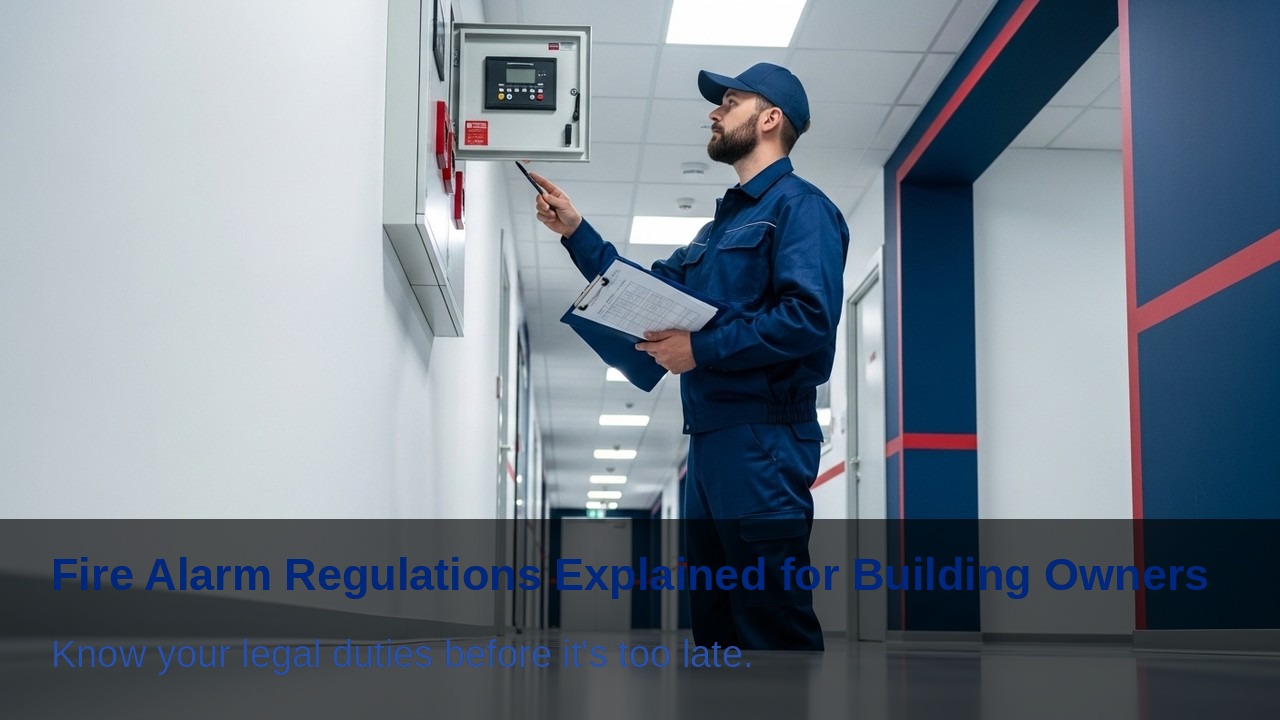
Under the Regulatory Reform (Fire Safety) Order 2005, every non-domestic premises must have a designated responsible person. This individual is legally accountable for carrying out or arranging a suitable fire risk assessment, putting in place appropriate fire safety measures, and keeping those measures up to date.
In most commercial settings, this duty falls on the employer or the building owner. In shared or multi-occupancy premises, it may apply to whoever has control over common areas.
For landlords managing residential blocks or houses in multiple occupation across areas such as Moss Side, Hulme, or Stretford, responsible person requirements extend to shared spaces including corridors, stairwells, and communal rooms. If you own a property but employ a managing agent, legal accountability does not automatically transfer. It is worth confirming in writing exactly where responsibility sits, because enforcement authorities will look for a specific individual to hold accountable.
Legal Duties for Fire Alarms in Commercial and Residential Properties
Your legal duties for fire alarms begin with the fire risk assessment. The Regulatory Reform (Fire Safety) Order 2005 requires the responsible person to identify fire hazards within the building, evaluate the risk to occupants, determine what detection and alarm measures are appropriate, and review and update the assessment regularly, especially after building alterations or changes in occupancy.
Beyond assessment, the law requires that fire detection and alarm systems are installed to an appropriate standard, regularly tested, and maintained in working order. BS 5839-1 is the benchmark recognised by enforcement authorities for non-domestic premises. Meeting the minimum legal requirement and meeting best practice are not always the same thing, and that gap can matter significantly in an insurance or enforcement context.
Workplace Fire Alarm Rules for Employers and Business Occupiers in Greater Manchester
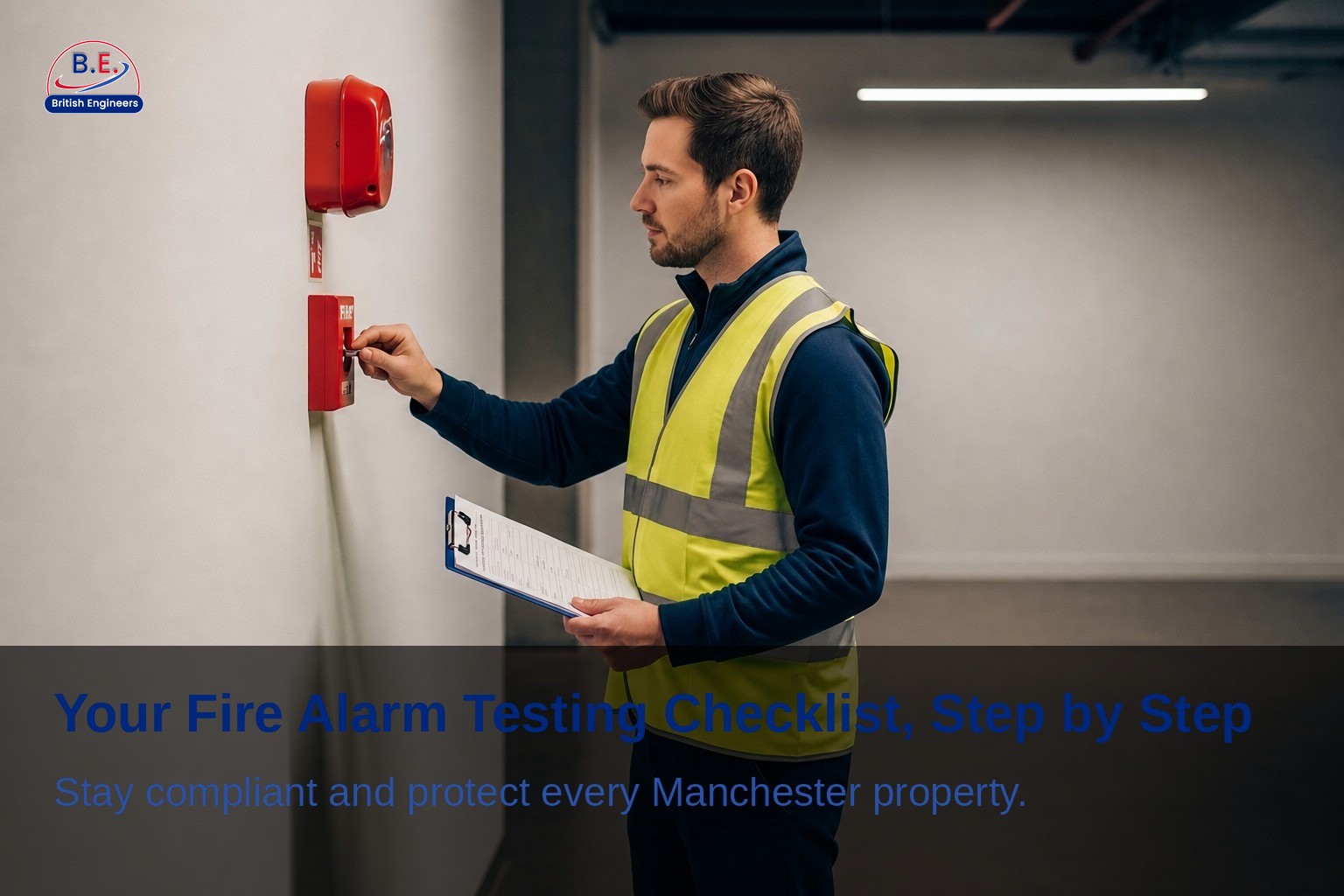
Workplace fire alarm rules place specific obligations on employers and business occupiers. Staff must be able to hear the alarm clearly from any location within the premises. A documented evacuation procedure must be in place, and all employees must be trained to follow it. Weekly manual call point tests are standard practice, with records kept as evidence of compliance. Alarm systems must cover the entire workplace, including areas where lone workers may be present outside core hours.
The London Fire Brigade notes that the appropriate type and coverage of alarm system depends on the size, layout, and risk profile of the building. A small office unit does not require the same complexity as a large warehouse or care home, but both must meet the standard appropriate to their use and occupancy. This applies equally to commercial premises throughout Manchester, from small independent units in the Northern Quarter to larger industrial and logistics facilities across Trafford Park.
Fire Detection Obligations for Landlords and Property Managers
Residential landlords must meet fire detection obligations under a combination of legislation, including the Fire Safety (England) Regulations 2022 and, for HMOs, the Housing Act 2004. These rules require appropriate fire detection installed and maintained throughout the property, with detection on every storey where there is a living space. For HMOs, compliance is typically aligned with BS 5839-6 for domestic premises and BS 5839-1 for larger managed buildings. For purpose-built residential blocks, regular checks of communal fire detection equipment are required, with records accessible to residents and enforcement authorities.
The UK Government’s Fire Kills campaign has long highlighted that you are around eight times more likely to die in a fire without a working smoke alarm. Landlords across Greater Manchester who treat detection as an afterthought are not only risking enforcement action; they are risking lives.
How Often Fire Alarms Should Be Tested and Serviced
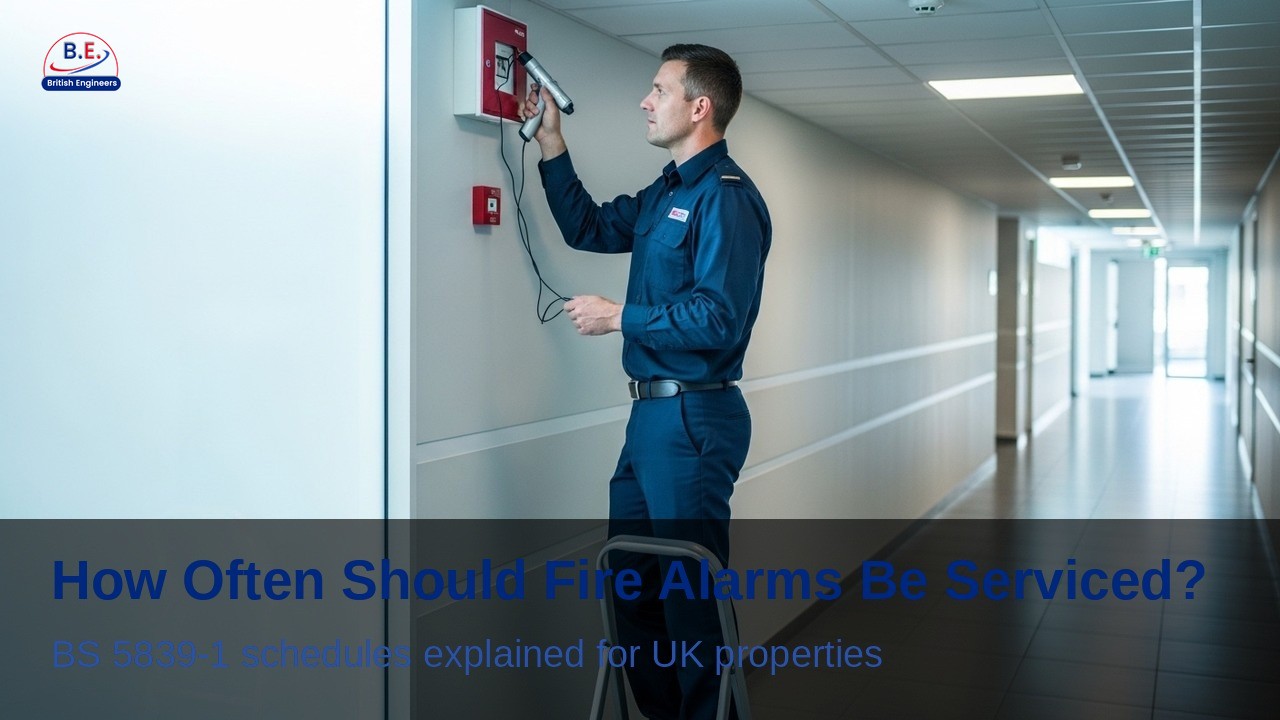
Testing and servicing follow a structured schedule under UK fire safety rules. In commercial premises, at least one manual call point should be tested weekly, rotating locations over time. A formal service visit by a competent engineer is recommended every six months under BS 5839-1 for most non-domestic premises, covering all detection devices, wiring and control panels, battery backup, and resulting in a service report. Following any significant building alteration, change in occupancy, or new equipment installation, the system should be reviewed and tested again.
The difference between a routine weekly check and a professional service inspection is significant. One confirms the system is functioning on that day; the other provides a thorough assessment of the system’s overall condition and compliance status. All records must be maintained accurately and made available for inspection.
| Activity | Frequency | Who Carries It Out | What It Covers |
|---|---|---|---|
| Manual call point test | Weekly | Responsible person or trained staff member | Confirms system is operational on that day; location rotated over time |
| Formal service inspection | Every six months (BS 5839-1) | Qualified fire alarm engineer | All detection devices, control panels, wiring, battery backup; service report issued |
| Post-alteration review | After any significant building change | Qualified fire alarm engineer | Detection coverage, alarm audibility, system compliance with current standards |

When to Call a Qualified Fire Alarm Engineer
Some situations clearly require a qualified engineer rather than in-house management. These include new installations or system upgrades, fault investigations following repeated false alarms, changes to building layout that affect detection coverage, and any circumstances where you are unsure whether the current system meets current standards.
Attempting to install or significantly modify a fire alarm system without qualified oversight is a serious risk. It can leave gaps in detection coverage that breach fire alarm installation standards, invalidate your building’s insurance, and create personal liability for the responsible person if an incident occurs.
Justin Maltby-Smith, Managing Director of BAFE, stated in an official BAFE publication: “This information clearly outlines that it is extremely important that any work on Grade D fire detection and fire alarm systems is performed in compliance with the appropriate current regulatory and competency documents available.” This principle applies across all grades and categories of system. The cost of an engineer’s assessment is negligible compared to the cost of non-compliance.
What to Check Before Choosing a Fire Alarm Installer
Choosing the right installer is as important as understanding the regulations themselves. Before any work begins, verify that the engineer holds relevant certifications and the company has experience with your building type. A site survey should be carried out before any quote is issued, and the installer should ask about occupancy patterns and building use before recommending a system. After installation, you should receive a full commissioning certificate, an as-installed drawing, and a log book for ongoing maintenance records. Quotations should be transparent with no hidden costs, and quality-specified equipment should be used.
These documents form the basis of your compliance record and will be essential in any enforcement inspection or insurance claim.
At British Engineers, our certified team works with homeowners and property managers across Manchester and the wider Greater Manchester area, including Salford, Stockport, Oldham, and Tameside, to install and maintain fire alarm systems that meet current regulatory standards. We provide honest consultations, clear pricing, and long-term support that keeps your building protected and your compliance record intact. If you are unsure where your current system stands or need a new installation, get in touch with our team today.
Frequently Asked Questions About Fire Alarm Regulations
Do fire alarm regulations apply to residential properties in the UK?
Yes. While the Regulatory Reform (Fire Safety) Order 2005 focuses on non-domestic premises, residential landlords and HMO owners are covered by the Fire Safety (England) Regulations 2022 and the Housing Act 2004. These require appropriate fire detection on every storey, regular maintenance, and accurate record-keeping, particularly in shared or multi-occupancy buildings.
Who is legally responsible for fire alarm compliance in a rented commercial property?
In most cases, the employer or whoever has day-to-day control of the premises is designated the responsible person under the Regulatory Reform (Fire Safety) Order 2005. If a landlord retains control of common areas, responsibility is shared. Lease terms do not override statutory duties, so both parties should confirm responsibilities in writing.
How often does a fire alarm system need to be professionally serviced?
BS 5839-1 recommends a formal service inspection every six months for most non-domestic premises, covering all detection devices, control panels, wiring, and battery backup. Weekly manual call point tests should also be carried out by the responsible person or a trained staff member, with records kept for each test.
What happens if a building owner fails to comply with fire alarm regulations?
Non-compliance with the Regulatory Reform (Fire Safety) Order 2005 can result in enforcement notices, substantial fines, and in serious cases, prosecution and imprisonment. It can also invalidate building insurance. Local fire and rescue authorities carry out inspections and have powers to prohibit use of premises that present a serious risk.
Does a change in building layout require a new fire risk assessment?
Yes. Any significant change to a building’s layout, occupancy, or use should trigger a review of the fire risk assessment and a check of detection coverage. Alterations can create undetected zones or affect alarm audibility. A qualified engineer should assess whether the existing system remains appropriate after changes are made.
Is a BS 5839-1 compliant system required for all commercial premises in Manchester?
BS 5839-1 is the recognised benchmark for fire detection and alarm systems in non-domestic premises across England, including Manchester. While it is a British Standard rather than a statutory instrument, compliance is expected by enforcement authorities and insurers. The specific system category required depends on the building’s size, use, and risk profile.