Key Takeaways
British Engineers provides a clear, stage by stage fire alarm testing checklist to help UK property owners and managers stay legally compliant and protect lives.
- Weekly fire alarm testing is a legal requirement under the Regulatory Reform (Fire Safety) Order 2005 and British Standard BS 5839 1, making consistent routine testing essential for all responsible persons managing non-domestic or multi-occupied buildings.
- Rotate the manual call point tested each week so that every device across the building receives regular verification over time, as testing the same point repeatedly leaves others unchecked and creates compliance gaps.
- After each weekly test, your fire panel test records must include the date, the specific call point activated, the name of the tester, and details of any anomalies; a test without a written record is legally considered a test that never took place.
- Sounders must be audible throughout the entire premises including stairwells, plant rooms, and basement areas, so having a colleague confirm audibility in the most isolated part of the building during each sounder test procedure is strongly recommended.
- Recurring faults, uncleared error codes, or any issue outside normal parameters should be referred promptly to a certified engineer rather than reset and ignored, as unresolved faults can leave a system appearing functional when it is not.
A fire alarm testing checklist is one of the simplest tools available to property owners and managers, and one of the most important. Carried out consistently each week, a structured test confirms that your system will respond when it matters most. For properties across Manchester and the wider North West, staying on top of this routine is not just good practice; it is a legal obligation. This guide walks you through every stage in plain, straightforward language so that anyone responsible for a building’s fire safety can approach the process with confidence.
According to UK Government fire statistics, buildings with properly functioning fire alarm systems tend to have significantly better safety outcomes than those without. Maintaining your system through regular testing is one of the most direct actions you can take to protect the people and property in your care.
Why Weekly Fire Alarm Testing Matters for Manchester Properties
Weekly fire alarm testing is a legal requirement under the Regulatory Reform (Fire Safety) Order 2005 and British Standard BS 5839-1. These two frameworks define what is expected of the Responsible Person, the individual legally accountable for fire safety in a non-domestic or multi-occupied building.
Failing to test and record results consistently can lead to an Enforcement Notice from Greater Manchester Fire and Rescue Service, bringing both operational disruption and serious legal consequences. Bedford Borough Council’s guidance on fire alarm testing confirms that both weekly and six-monthly tests must be conducted and recorded for a system to be considered operationally compliant under BS 5839-1.
Beyond legal compliance, the practical stakes are significant. Fire safety organisations consistently highlight that a large proportion of businesses affected by major fires struggle to reopen, making prevention and early detection critical. This risk applies equally to commercial premises in Salford, Trafford, and Manchester city centre. Completing your weekly check directly reduces the likelihood that a fault will go unnoticed long enough to compromise a real emergency response.
What You Need Before Starting Your Fire Alarm Test
Good preparation makes each weekly test faster and more reliable. You do not need specialist tools for a weekly check, but you do need a clear understanding of your system and your building. Have these items ready before you begin:
- Access to the fire alarm control panel
- Your fire safety log book or a reliable digital equivalent
- The system’s manual and a building plan showing call point locations
- A record of which call point was tested most recently, so you can rotate correctly
Familiarise yourself with your system’s normal operating sounds and display states before you start. Most standard fire alarm panels display a steady green light during normal operation, and any deviation warrants attention. If you are unsure about your panel’s specific indicators, consult the manufacturer’s manual or speak to a qualified engineer before conducting the test alone.
How to Complete Your Weekly Fire Alarm Test, Stage by Stage
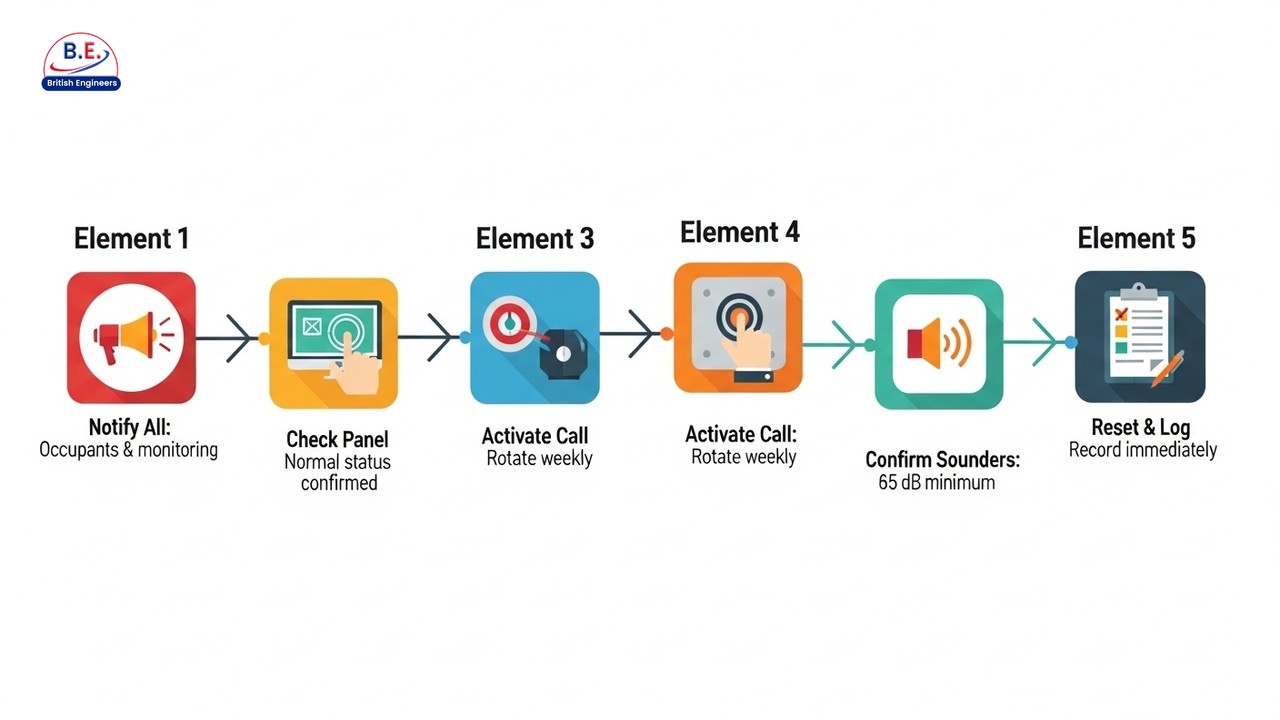
The weekly fire alarm test follows a consistent sequence. Work through each stage in order:
- Notify all occupants that a test is about to take place, to prevent unnecessary evacuation.
- Inform your monitoring centre so the alert is not treated as a genuine emergency.
- Check the control panel to confirm it is showing normal operational status.
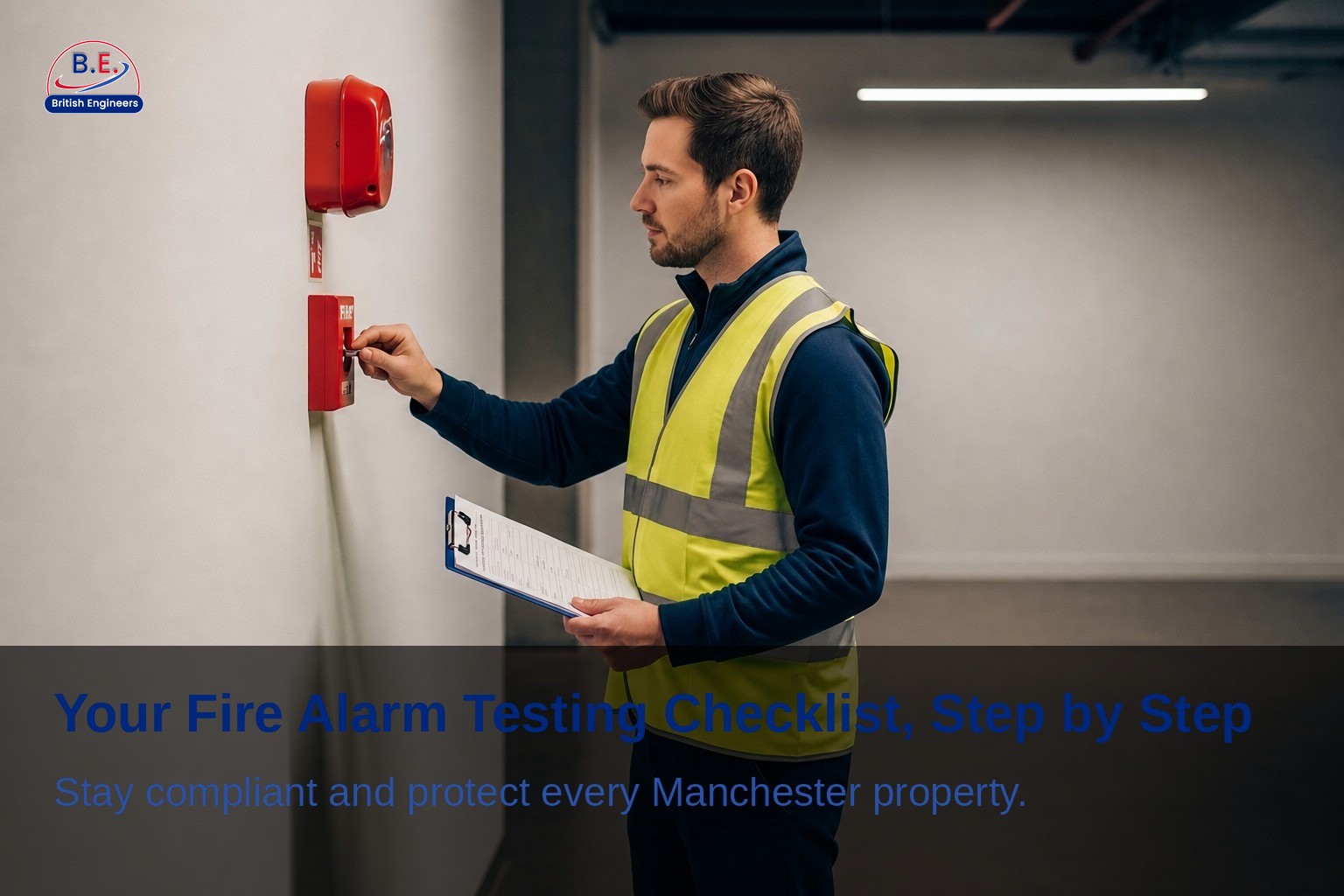
- Activate the selected manual call point using the test key, without breaking the glass element.
- Confirm the sounder response by checking that alarms activate promptly throughout the building.
- Return to the panel, reset the system, and record the result in your log book immediately.
| Stage | Action | Who Is Responsible |
|---|---|---|
| 1 | Notify all occupants that a test is about to take place | Responsible Person or trained staff member |
| 2 | Inform the monitoring centre to prevent a false emergency response | Responsible Person or trained staff member |
| 3 | Check the control panel is showing normal operational status | Responsible Person or trained staff member |
| 4 | Activate the selected manual call point using the test key | Responsible Person or trained staff member |
| 5 | Confirm sounder response throughout the building | Responsible Person or trained staff member |
| 6 | Reset the panel and log the result in the fire safety log book | Responsible Person or trained staff member |
How to Test a Manual Call Point Correctly
BS 5839-1 requires that a different manual call point is tested each week, so that all devices across the building receive regular verification over time. Note the zone and specific device tested in your log book, then move to an adjacent call point the following week. This rotation is central to any reliable fire alarm maintenance checklist and ensures no single call point is overlooked.
If the selected call point does not trigger the alarm as expected, do not reset and move on. Follow these steps instead:
- Check that the device is properly connected and shows no visible damage.
- Reset the panel and repeat the test once.
- If the fault persists, log it in detail and contact a certified engineer before the next scheduled test.
Research into fire alarm reliability consistently shows that testing remains inconsistent across many properties, which is precisely why a structured, rotating approach matters so much for genuine compliance.
How to Check Your Sounders Are Working Properly
When the call point activates, listen carefully across the building rather than simply confirming the nearest sounder is working. The sounder check should confirm that alarm tones reach every area of the premises, including plant rooms, stairwells, and any ground-floor or basement spaces that are easy to overlook. This is particularly relevant in older Manchester buildings or converted commercial premises, where layout complexity can create coverage blind spots.
Under BS 5839-1, alarm sounders must be audible throughout the premises at a minimum of 65 dB(A), rising to 75 dB(A) at the pillow in sleeping-risk areas, as specified by the British Standards Institution. For large or multi-floor buildings, have a colleague stand in the furthest or most isolated part of the property during the test to confirm audibility there.
Note any area where the sounder appears quieter than expected or where the tone is not clearly heard. This could indicate a faulty sounder unit or a zone coverage gap, both of which should be logged and referred to an engineer promptly.
How to Record Your Fire Alarm Test Results
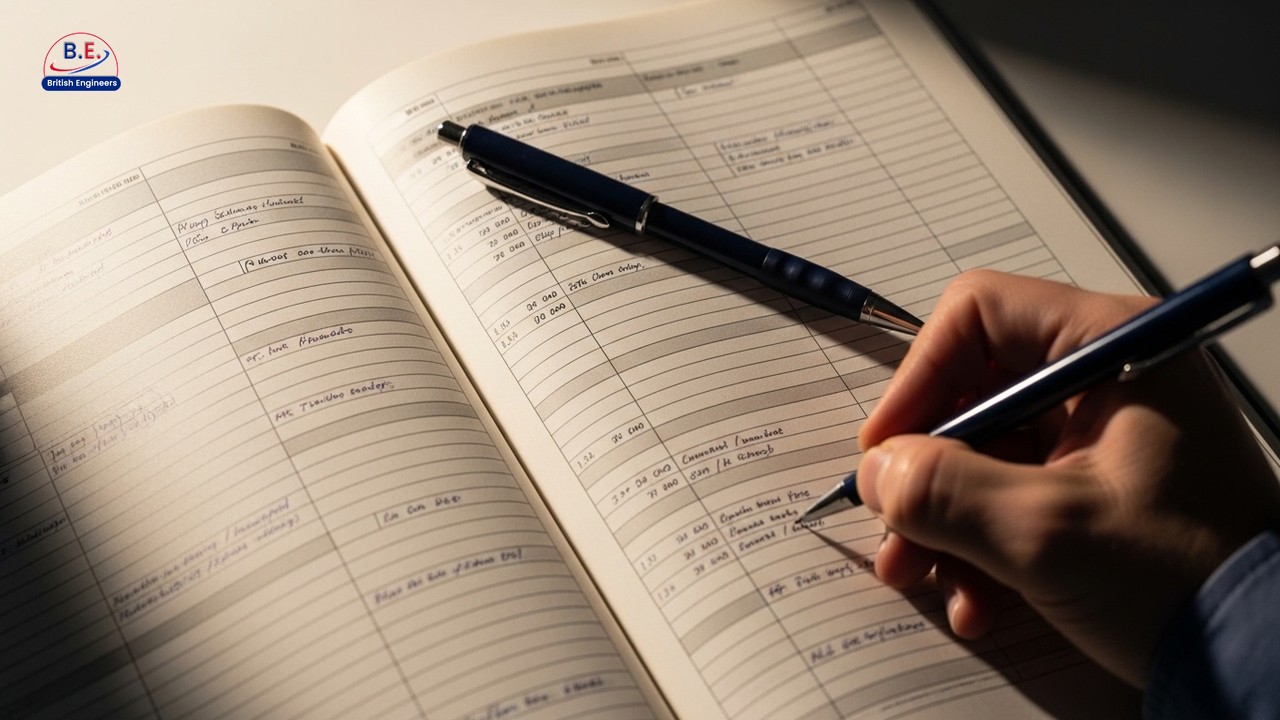
Accurate record-keeping is as important as the test itself. After each weekly check, your log book entry must include the date of the test, the specific call point activated, the name of the person who conducted the test, whether the system responded normally, and a brief description of any anomalies along with the steps taken in response. These entries form your documented evidence of compliance and must be available for inspection by Greater Manchester Fire and Rescue Service at any time.
It is worth distinguishing between weekly log entries and records from professional service visits. Weekly entries are made by the Responsible Person or a trained member of staff. Quarterly and annual records are completed by certified engineers following detailed inspections covering detectors, interfaces, relays, and cause-and-effect verification. Both types of record belong in the same log book but should be clearly labelled so any inspector can tell them apart at a glance.
| Record Type | Who Completes It | Frequency | What It Covers |
|---|---|---|---|
| Weekly test log | Responsible Person or trained staff | Every week | Date, call point tested, tester’s name, system response, any faults noted |
| Quarterly service record | Certified fire alarm engineer | Every quarter (where required) | Detector checks, zone verification, panel interfaces, relay functions |
| Six-monthly inspection record | Certified fire alarm engineer | Every six months | Full system inspection, cause-and-effect verification, compliance assessment |
| Annual service record | Certified fire alarm engineer | Yearly | Comprehensive review of all system components and documentation |
Common Mistakes That Undermine Weekly Testing
Even conscientious property managers can fall into habits that weaken their testing routine. Three errors appear most frequently:
- Testing the same call point every week — rotating devices is a requirement under BS 5839-1, not an optional extra.
- Resetting after a failed activation without investigating — this creates gaps in your compliance record and leaves faults unresolved.
- Failing to log results at all — from a legal perspective, a test without a record is a test that did not happen.
If an incident occurs and your log book does not show recent, consistent entries, the Responsible Person faces serious liability under the Regulatory Reform (Fire Safety) Order 2005. Small adjustments make consistent compliance straightforward: keep the log book at the panel, set a weekly calendar reminder, and brief all potential testers on the correct process.
When to Call a Certified Fire Alarm Engineer in Manchester
Weekly tests are designed to be conducted by trained, non-specialist staff, but there is a clear boundary between what the Responsible Person should handle and what requires professional expertise. Contact a qualified engineer if you notice any of the following:
- Recurring faults at the same call point
- Error codes on the panel that do not clear after a reset
- Sounders that fail to activate in a given zone
- Any situation requiring a post-incident inspection following a genuine fire
Attempting to diagnose or repair panel-level faults without the right training can void warranties and may leave the system in a state that appears functional but is not.
At British Engineers, our role extends well beyond installation. We support clients across Manchester, including properties in Salford, Stockport, Oldham, and the city centre, with ongoing maintenance that keeps fire alarm systems fully compliant and reliably operational. If you notice anything during your weekly test that falls outside normal parameters, our certified engineers are ready to investigate promptly and thoroughly. For guidance on how often a professional should service your system in full, explore how often fire alarms should be serviced, which covers the schedule of engineer-led inspections in detail.
Building a Fire Safety Routine That Works Long-Term
The most effective fire safety routines are the ones that become second nature. Treat your fire alarm testing checklist as a short, repeatable habit rather than a compliance burden, and it will take no more than a few minutes each week. The core sequence is straightforward: notify occupants and your monitoring centre, activate a rotated manual call point using the test key, confirm sounder response throughout the building, reset the panel, and log the result with all required details.
Every property is different. A building with multiple floors, plant rooms, or mixed occupancy needs a testing approach that reflects its specific risk profile, and this is as true of a Deansgate office block as it is of a warehouse in Trafford Park. At British Engineers, we offer consultations tailored to your building’s layout, occupancy, and risk factors so your routine is built around your property, not a generic template. If you would like to discuss how we can support your fire safety compliance across Manchester and the surrounding area, get in touch with our team today.
Frequently Asked Questions About Fire Alarm Testing
What is included in a fire alarm testing checklist?
A fire alarm testing checklist covers notifying occupants and the monitoring centre, checking the control panel status, activating a manual call point with a test key, confirming sounder response across the building, resetting the panel, and logging the outcome in your fire safety log book to demonstrate compliance with BS 5839-1.
How often should I test my fire alarm system in the UK?
Under BS 5839-1 and the Regulatory Reform (Fire Safety) Order 2005, fire alarms in non-domestic premises must be tested weekly by the Responsible Person. A certified engineer should also carry out a full inspection at least every six months, with some systems requiring quarterly visits depending on their complexity.
Do I need to rotate manual call points during weekly tests?
Yes. BS 5839-1 requires a different call point to be tested each week so that all devices are verified over time. Testing the same device every week does not satisfy this requirement. Keep a record of which call point was last tested so you can move systematically through all zones in your building.
What should I do if a call point fails during a weekly test?
Do not simply reset the panel and move on. Check for visible damage or a loose connection, then repeat the test once. If the fault persists, log it with full details and contact a certified fire alarm engineer before your next scheduled test. An unresolved fault creates both a compliance gap and a genuine safety risk.
What records must I keep for fire alarm testing in Manchester?
Every weekly test must be logged with the date, the call point tested, the tester’s name, whether the system responded correctly, and details of any faults or follow-up actions. These records must be available for inspection by Greater Manchester Fire and Rescue Service at any time and should be kept in a dedicated fire safety log book.
Can I carry out weekly fire alarm tests myself, or do I need an engineer?
Weekly tests can be carried out by the Responsible Person or a trained member of staff without specialist qualifications. However, faults identified during testing, recurring panel errors, or zones failing to activate must be referred to a certified engineer. Professional servicing is also required at least every six months under BS 5839-1.