
Key Takeaways
British Engineers explains how to identify when fire alarm upgrades and replacements are needed and what modern systems offer for homes and commercial properties.
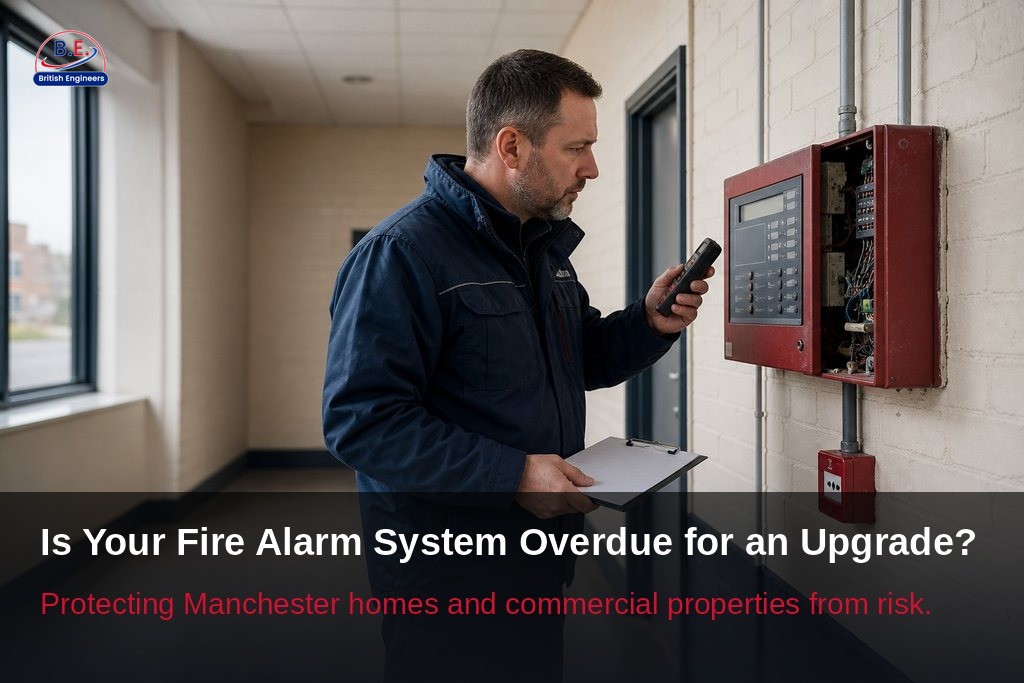
- An older fire alarm that powers on and appears functional may still be unreliable, non compliant, or incapable of performing correctly during an actual fire event.
- Clear signs that indicate when to replace fire alarms include frequent false alarms, discontinued parts, recurring faults across multiple components, and coverage gaps in extended or converted areas.
- Upgrading old alarm panels differs from full replacement; targeted component upgrades often cost between 20 and 40 percent of full replacement cost when the existing panel is still supported.
- Modern fire detection upgrades offer addressable systems for precise fault location, remote monitoring via cloud platforms, and compatibility with current communication networks replacing retired analogue lines.
- Before any work begins, confirm that engineers hold relevant qualifications, that a physical site survey is included, and that quotations are fully itemised with clear aftercare terms.
Fire alarm upgrades and replacements are not conversations most property owners plan until something goes wrong. Yet for many homes and commercial buildings across Manchester and the surrounding areas, the system currently fitted to the wall may be quietly falling behind the standard needed to protect lives. A system that powers on and occasionally beeps can still be unreliable, non-compliant, or simply incapable of performing when it matters most. Understanding where your installation stands is the first step toward genuine fire safety, rather than a false sense of security.
This article forms part of a broader fire alarm compliance guide covering regulatory obligations and maintenance best practice. Here, the focus is on helping homeowners and property managers make sense of the upgrade and replacement decision: what it involves, what modern systems actually offer, and how to approach the process with confidence.
Why Outdated Fire Alarm Systems Are More Common Than You Think
A surprisingly high number of properties across Greater Manchester and the wider UK are still running on fire alarm systems installed under older British Standards, often without the current occupants realising the implications. Technology and regulatory requirements have evolved considerably over the past two decades. A system that was fully compliant at the time of installation may no longer meet today’s standards, and that gap is not always visible to the untrained eye.
Part of the problem is that older systems often continue to function in a basic sense. Panels display as normal, detectors trigger during testing, and nothing obvious flags a concern during routine checks. However, component reliability deteriorates over time. Research published by ScienceDirect (Elsevier) on fire alarm system performance confirms that allowing equipment to reach the wear-out phase is a key risk factor, one that proactive upgrading can help prevent. A system that appears functional is not necessarily one that will perform correctly during an actual fire.
There is also the question of communication infrastructure. Many older systems relied on analogue telephone lines (PSTN) or earlier mobile network generations to transmit signals to monitoring centres. As these technologies are progressively retired across the UK, communicators built around them become non-functional, leaving properties without the remote monitoring capability they may have depended on for years.
Warning Signs That It Is Time to Replace Your Fire Alarm
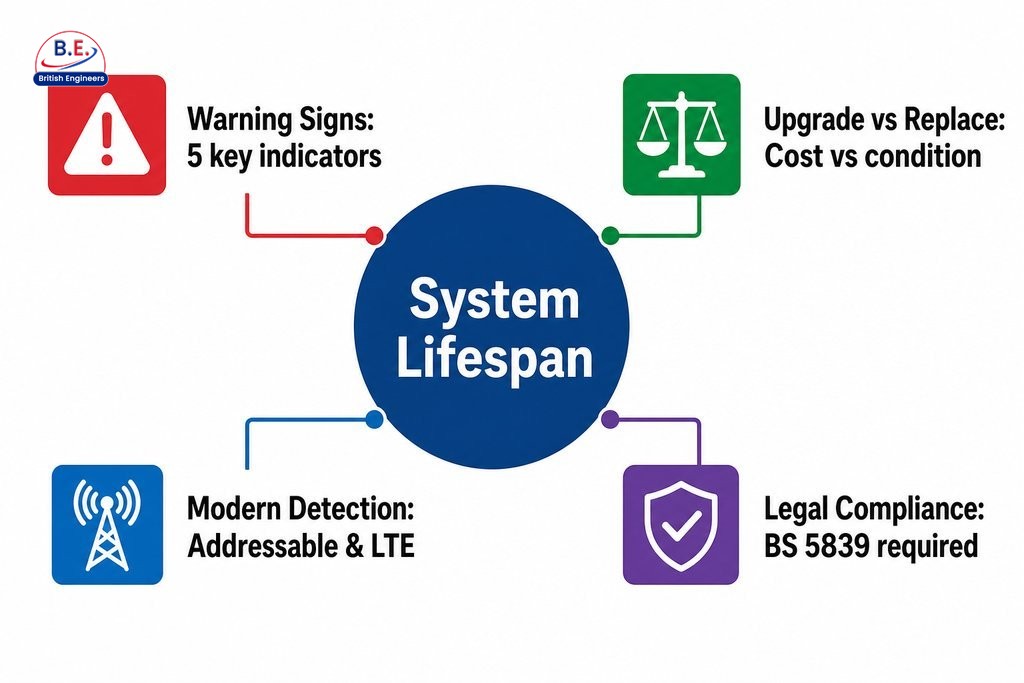
Knowing the signs your fire alarm system needs upgrading can save you from a costly emergency further down the line. Some indicators are obvious; others are easy to miss. The most common warning signs are:
- Frequent false alarms or unexplained activations
- A panel that regularly displays faults or fails during routine tests
- Discontinued components that are no longer manufactured or stocked
- A system that predates the current edition of BS 5839 or lacks coverage in converted or extended areas
- An interface so outdated that your engineer struggles to interpret it
Discontinued parts are one of the clearest signals that a system has reached the end of its reliable service life. When replacement components are no longer available, every subsequent fault becomes harder and more expensive to resolve. Research by the National Institute of Standards and Technology (NIST) found that properties with working, reliable smoke alarms had measurably lower fire casualty rates, underscoring how much individual component reliability matters.
| Warning Sign | What It Indicates | Recommended Action |
|---|---|---|
| Frequent false alarms or unexplained activations | Detector sensitivity has degraded or components are failing | Engineer inspection; possible detector replacement |
| Panel faults or failures during routine tests | Panel or zone card deterioration | Assessment of panel condition and parts availability |
| Discontinued components no longer in stock | System has reached end of supported service life | Full replacement assessment |
| System predates current BS 5839 edition | May not meet current compliance requirements | Compliance review by qualified engineer |
| Engineer unable to interpret the interface | Obsolete technology with no current support | Full replacement likely required |
The Difference Between a Fault and a Failing System
Not every fault means a full replacement is necessary. A single detector developing a fault, a communicator needing an update, or a failed zone card can often be resolved as an isolated repair. The important distinction is between a fixable fault in an otherwise sound system and a pattern of recurring issues that point to broader deterioration.
If engineers are returning repeatedly to address different failures across the same installation, that pattern reflects the overall condition of the system, not just the individual parts. End-of-life panel status and parts availability are the two most critical factors in deciding whether to upgrade or fully replace. Understanding the fire alarm system lifespan of your current equipment is central to making an informed decision rather than a reactive one.
Upgrade or Full Replacement: Understanding the Difference
Fire alarm upgrades and replacements are not the same thing, and the right course of action depends on the specific condition of your existing installation.
An upgrade typically involves replacing individual components, such as detectors, communicators, or modules, while retaining a panel that is still supported and has an available parts supply. A full replacement involves removing the existing system entirely and installing new infrastructure, including the control panel, wiring where necessary, and all connected devices.
The financial difference between these two paths can be significant. According to Life Safety Consultants, targeted component upgrades often cost considerably less than full replacement. Where a panel is still supported and parts are available, upgrading may deliver better return on investment over a five to seven year horizon than replacing prematurely. Building size, occupancy type, existing wiring, and compliance requirements all influence where your property sits within that decision, and none of these can be assessed reliably without a physical inspection by a qualified engineer.
| Factor | Upgrade | Full Replacement |
|---|---|---|
| Scope of work | Individual components replaced; panel retained | Entire system removed and reinstalled |
| Relative cost | Lower upfront investment | Higher upfront investment |
| Best suited when | Panel is still supported and parts are available | Panel is end-of-life or parts are discontinued |
| Compliance outcome | Depends on existing system condition | Fully certified to current BS 5839 |
| Long-term reliability | Good over a 5 to 7 year horizon if system is sound | Highest reliability and longevity |
| Disruption level | Lower; targeted work by zone or component | Higher; full installation programme required |
What Modern Fire Detection Systems Actually Offer
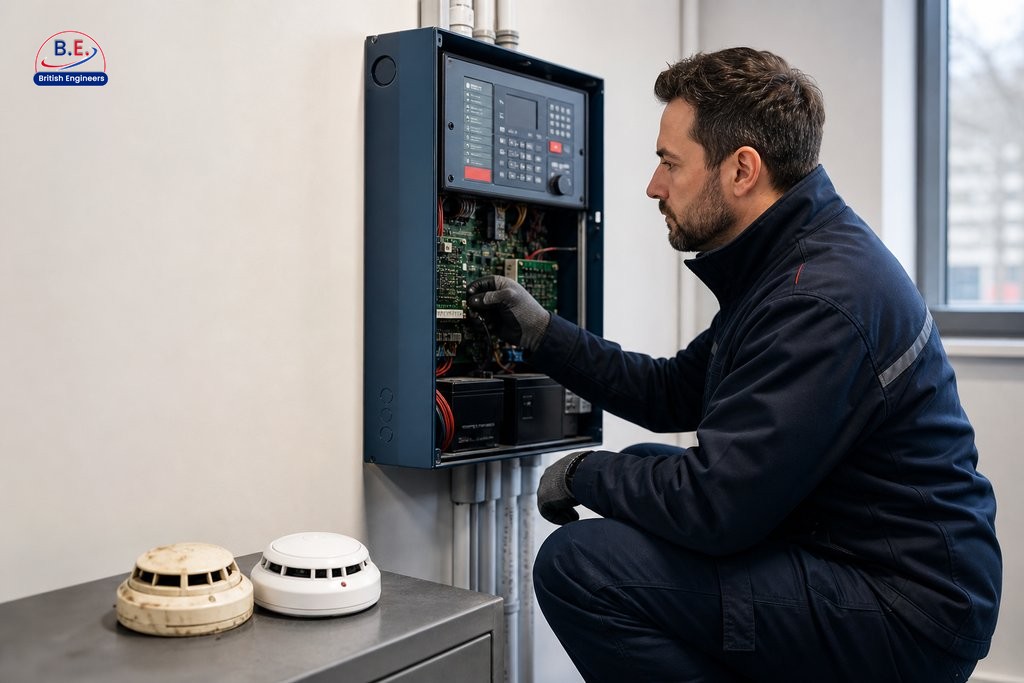
Upgrading old panels and sensors brings practical, measurable improvements rather than simply like-for-like replacements. The key benefits of modern fire detection systems include:
- Addressable detection: Each detector is individually identifiable within the panel, so faults are located precisely and quickly rather than traced across an entire zone.
- Remote monitoring: Cloud-based platforms allow system diagnostics, alarm history, and compliance records to be accessed and managed remotely. This is particularly useful for property managers overseeing multiple sites across Manchester and beyond.
- Updated communications: Modern communicators use LTE and 5G technology, replacing outdated PSTN and 3G systems being retired across the UK.
- Faster fault response: Addressable systems reduce the time engineers spend diagnosing issues, which can lower maintenance costs over the long term.
The shift toward LTE and 5G communicators reflects a broader movement in the industry toward integrated, future-ready fire safety infrastructure. As noted in trade publications covering the security and fire sector, dealers have been actively upgrading older 3G communicators to current cellular technology as network retirement programmes take effect. It is worth noting that modern technology enhances reliability and reporting capability; it does not remove the need for regular physical maintenance and professional inspection.
Compliance, Standards, and When Professional Guidance Is Essential
In the UK, fire alarm design, installation, and commissioning for commercial premises is governed by BS 5839, the primary British Standard for fire detection and alarm systems in buildings. Compliance is not optional for most commercial property managers. It forms part of the obligations under the Regulatory Reform (Fire Safety) Order 2005, which requires a suitable and sufficient fire risk assessment and appropriate fire detection measures to be in place.
Residential landlords also carry obligations under housing legislation. Properties converted into houses of multiple occupation, common across areas such as Salford, Stretford, and parts of inner Manchester, may face additional requirements that the original alarm installation did not meet.
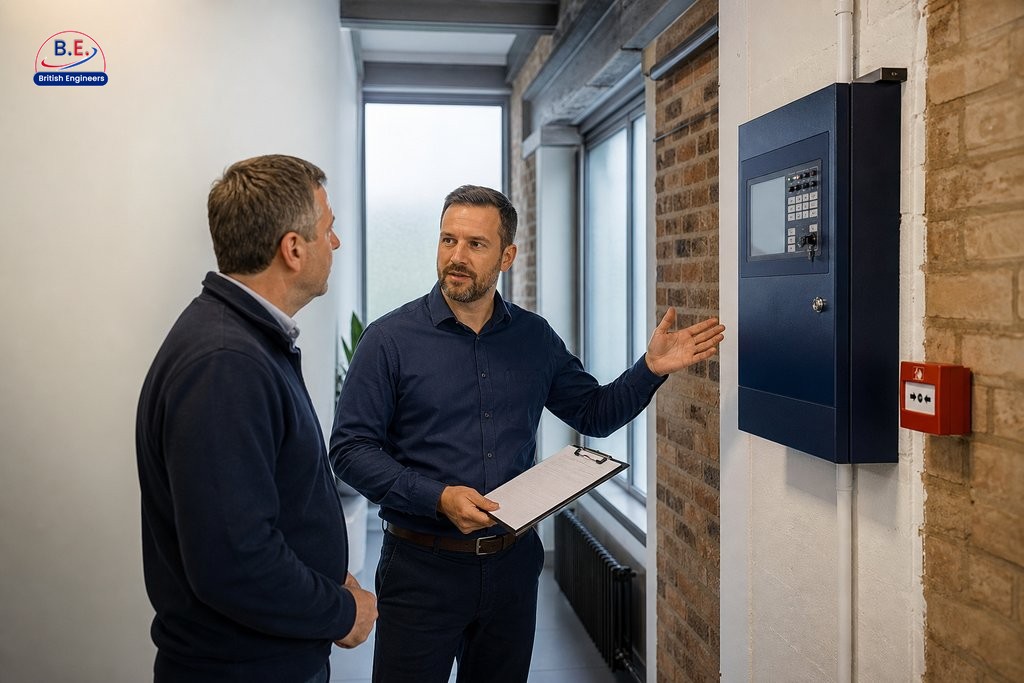
Compliance is not simply a matter of having a fire alarm fitted. The system must be appropriate for the building type, coverage must be adequate for the occupancy, and the installation must be certified by qualified engineers. A system installed without proper certification, or one that has not been maintained in line with manufacturer and standard requirements, may not be considered compliant even if it appears to be functioning. This is one area where professional guidance is essential, not optional.
What to Confirm Before Any Work Begins in Manchester
Before commissioning any upgrade or replacement, confirm the following to protect your investment and ensure the work is completed correctly:
- Engineers hold relevant qualifications and can certify the completed installation in line with BS 5839.
- The quotation is itemised and transparent, with no undefined costs or unexplained variables.
- The scope of work includes a site survey and written recommendation, not just a price without prior assessment.
- Aftercare and maintenance terms are clearly explained, including what is covered and how ongoing support is arranged.
How British Engineers Approaches Fire Alarm Assessments Across Greater Manchester
At British Engineers, every fire alarm assessment begins with a personalised site consultation rather than a standard package recommendation. No two properties have the same layout, occupancy pattern, or existing infrastructure. The right solution for a converted commercial unit in Manchester city centre will look quite different from the right solution for a residential landlord managing a mid-terrace property in Salford or a mixed-use development in Stockport. Our engineers take the time to understand the specific context of each property before making any recommendation about whether an upgrade or a full replacement is the appropriate route forward.
Our team works with premium-grade equipment and certified professionals, which means the systems we install and upgrade are built for long-term reliability. We provide ongoing maintenance support as a continuation of the service we started at installation. Transparent quotations are a core part of how we work: you receive a clear breakdown of what is involved and what it will cost, with no ambiguity built in.
If you have concerns about your current system, are approaching a compliance review, or simply want to understand where your fire alarm installation stands against current standards, we would be glad to help. Get in touch with British Engineers today to arrange a site assessment and take the first step toward a fire safety setup you can genuinely rely on.
Frequently Asked Questions About Fire Alarm Upgrades and Replacements
How do I know if my fire alarm system needs replacing rather than repairing?
The clearest indicators are a pattern of recurring faults across different components, discontinued parts that are no longer available, and a panel that predates the current edition of BS 5839. A single fault can often be repaired in isolation, but repeated failures across the same installation suggest the system has reached the end of its reliable service life. A qualified engineer can assess this during a site visit.
How long does a fire alarm system typically last?
Most fire alarm systems have a practical service life of around 10 to 15 years, though this varies depending on equipment quality, usage, and maintenance consistency. Panels and detectors approaching or exceeding this range should be assessed by a qualified engineer to determine whether upgrading or full replacement is appropriate.
Is it a legal requirement to have a fire alarm in a commercial property in the UK?
Yes. Under the Regulatory Reform (Fire Safety) Order 2005, commercial property managers must carry out a fire risk assessment and ensure appropriate fire detection measures are in place. The specific system required depends on building type and occupancy. Non-compliance can result in enforcement action from the local fire authority.
What is the difference between an addressable and a conventional fire alarm system?
A conventional system divides a building into zones, and a fault triggers an alert for the entire zone. An addressable system assigns a unique identifier to each detector, so faults and activations are pinpointed to the exact device. Addressable systems are faster to diagnose, easier to maintain, and better suited to larger or more complex properties.
Will a fire alarm upgrade disrupt my business or tenants?
Most upgrade and replacement work can be phased or scheduled to minimise disruption. A reputable engineer will discuss the scope of work and agree on a programme before starting. In many cases, individual components or zones can be upgraded without taking the entire system offline at once.
Does my fire alarm system need to be certified after installation or upgrade?
Yes. Any new installation or significant upgrade should be certified by a qualified engineer in line with BS 5839. Certification confirms the system has been installed correctly, tested, and is fit for the building’s occupancy. Without it, the system may not be considered compliant during a fire risk assessment or insurance review.
