Key Takeaways
UK businesses must meet strict legal fire alarm requirements to protect occupants, maintain compliance, and avoid serious penalties under the Regulatory Reform (Fire Safety) Order 2005.
- Every commercial premises in the UK must have an appropriate fire detection system in place under the Regulatory Reform (Fire Safety) Order 2005, and the responsible person carries direct legal liability for compliance.
- A professional fire risk assessment is the foundation of your fire safety strategy and must identify your specific workplace alarm requirements, system category, and device placement rather than relying on assumptions about building size.
- Commercial premises alarm rules follow British Standard BS 5839 Part 1, which classifies systems by category and coverage level; the correct category must be determined by the risk assessment, not by cost or personal preference.
- Employer fire alarm obligations extend well beyond installation and include weekly testing, six monthly professional servicing, full log book records, and staff training on evacuation procedures.
- When choosing a fire alarm provider, verify that engineers hold relevant certifications, that installations meet current British Standards, and that ongoing maintenance support is included to keep your business fully compliant long term.
Fire alarm requirements for businesses are not simply a compliance checkbox. They are a legal obligation that protects lives, preserves livelihoods, and keeps commercial premises operating without interruption. Whether you manage a small retail unit in the Northern Quarter or oversee a multi-floor office building in Spinningfields, the rules are clear, the responsibilities are real, and the consequences of getting it wrong can be severe. This guide breaks down what the law expects from you, what your fire alarm system must include, and how to keep your premises fully protected and fully compliant.
According to UK Government Fire and Rescue Services Statistics, Fire and Rescue Services in England responded to over 3,700 fires at commercial or non-residential properties in just one quarter between April and June 2023. That figure is a strong reminder that fire risk in commercial settings is not theoretical. It is a present, measurable danger that demands proper preparation.
What the Law Requires from Business Owners
The primary legislation governing fire safety in commercial premises is the Regulatory Reform (Fire Safety) Order 2005. Under this order, all commercial premises in the UK must have an appropriate fire detection system in place.
The law does not prescribe a single system type for every building. Instead, it places the responsibility for determining the right system on the responsible person, typically the business owner, employer, or the individual in control of the building, who carries direct legal liability for compliance.
Business fire safety duties under this order include carrying out a fire risk assessment, putting appropriate fire safety measures in place, reviewing those measures regularly, ensuring everyone on the premises can evacuate safely, training staff on fire procedures, and maintaining accurate fire safety records.
Ignorance of the law is not a defence. Failure to comply can result in financial penalties, invalidated insurance, and in serious cases, potential imprisonment.
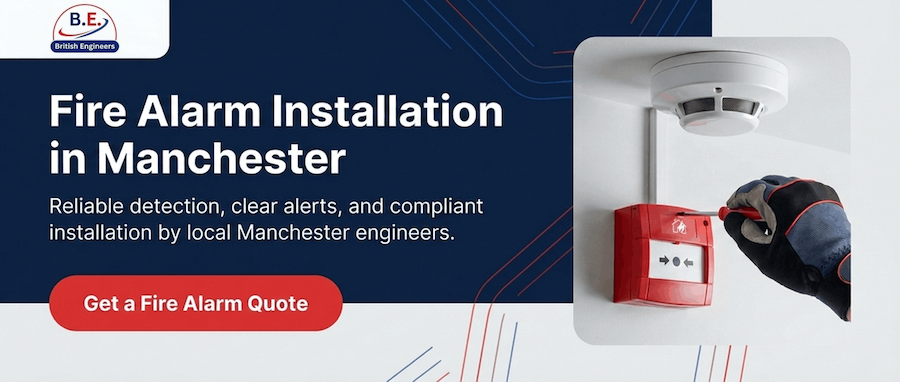
Do Businesses Need a Fire Alarm System by Law?
Yes, in almost all cases. The Regulatory Reform (Fire Safety) Order 2005 applies to virtually all non-domestic premises, including offices, shops, warehouses, hospitality venues, and shared workspaces. The type of system required depends on the size and layout of the building, the number of occupants, the nature of work carried out, and the outcome of a fire risk assessment.
For smaller premises with simple layouts and very few occupants, a basic manual warning system may be sufficient. For larger or more complex buildings, an automatic fire detection system is not just recommended; it becomes a legal necessity. The right approach must be driven by a proper risk assessment, not assumptions based on building size alone.
Understanding Your Fire Risk Assessment and Alarm Needs
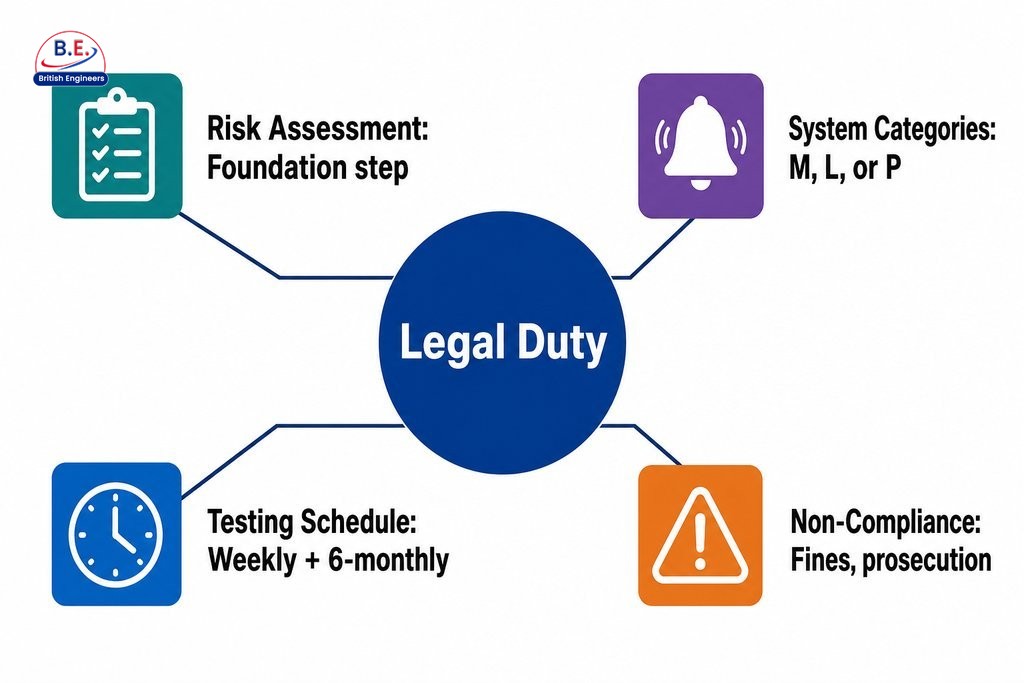
Your fire risk assessment is the foundation of your entire fire safety strategy. It identifies how fire could start and spread, who might be at risk, and what measures are needed to reduce that risk to an acceptable level. The assessment must be carried out by a competent person with sufficient knowledge and experience in fire safety. For larger or more complex premises, this typically means engaging a qualified fire safety professional.
The assessment is not a one-time task. It must be reviewed regularly and after any significant changes to the premises. It must be recorded in writing for any business with five or more employees, and all fire safety activity, including the assessment itself, must be kept on file for inspection.
What a Fire Risk Assessment Should Tell You About Your Alarm System
Once completed, your assessment should produce clear action points that translate directly into workplace alarm requirements for your building. These typically cover the appropriate grade and category of alarm system, the number and location of detection devices, positioning of call points and sounders, whether your current system meets the required standard or needs upgrading, and the timeframe for any improvements needed. This documented evidence also protects you legally by demonstrating that you have acted on known risks.
Fire Alarm System Types and Commercial Premises Alarm Categories
Commercial alarm system requirements are structured around the classification system defined by British Standard BS 5839-1. Systems fall into three main categories: Category L (life protection systems), Category M (manual systems), and Category P (property protection systems). Each category has subcategories specifying the level and location of detection required. Category L1, for example, provides detection throughout the entire building, while Category L3 focuses only on escape routes. The correct category for your premises is determined by the risk assessment, not by personal preference or budget alone.
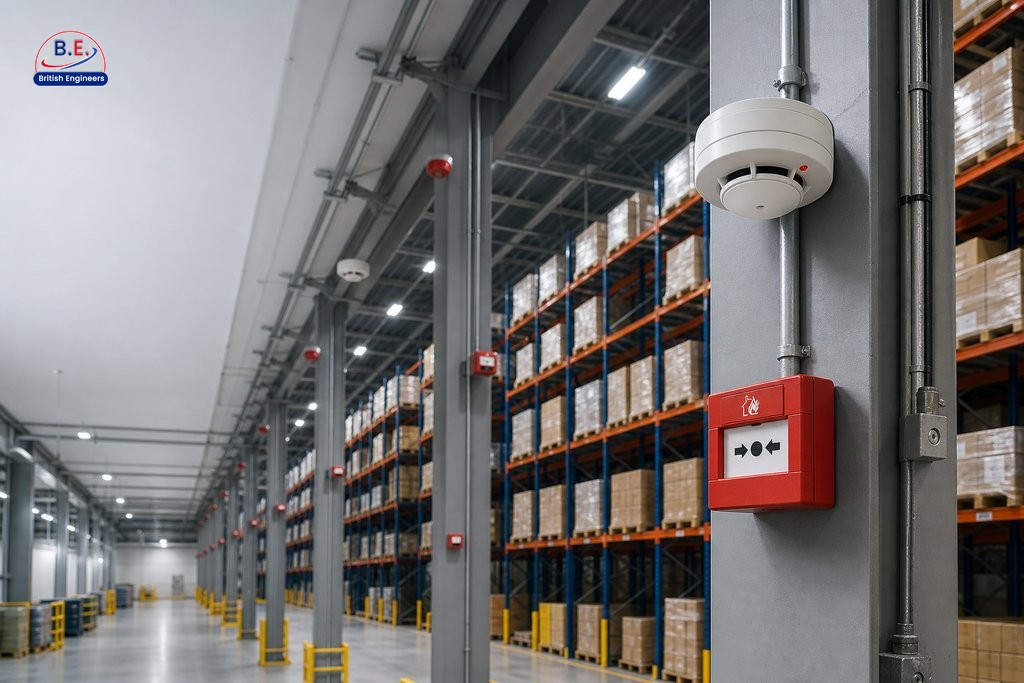
Building use and layout play a significant role. A warehouse in Trafford Park with high-racked storage presents very different challenges from an open-plan office in the city centre or a restaurant kitchen in Ancoats. The number of occupants, the presence of sleeping accommodation, escape route layouts, and materials stored or used all influence what detection is required and where it must be positioned. Fire alarm installation standards are closely tied to how accurately the system design reflects the specific risks of your building.
| Category | Purpose | Subcategories | Typical Application |
|---|---|---|---|
| Category M | Manual warning only | None | Small, low-risk premises with few occupants |
| Category L | Life protection (automatic detection) | L1 (whole building), L2, L3 (escape routes), L4, L5 | Offices, retail, hospitality, and larger commercial buildings |
| Category P | Property protection (automatic detection) | P1 (whole building), P2 (defined areas) | Premises where early fire detection is needed to protect assets or structure |
Employer Fire Alarm Obligations That Are Easy to Overlook
Getting a system installed is just the beginning. Employer fire alarm obligations extend well beyond installation day. Under BS 5839-1:2025, businesses must test fire alarms weekly, arrange a full professional service every six months, log every test, service visit, and fault in a dedicated fire alarm log book, and make that log book available for inspection at any time.
Staff training is another area where compliance gaps frequently appear. All employees should know how to raise the alarm, what the alarm signals mean, and what to do during an evacuation.
Research from the BRE (Building Research Establishment), supported by BAFE, found that the way fire detection and alarm systems are procured and maintained often results in significant non-compliance with BS 5839-1, including issues that create the potential for false alarms. This is reinforced by Home Office data showing that 42% of Fire and Rescue Service incidents in England for the year ending June 2020 were false alarms, with apparatus faults cited as the largest contributing factor.
As Stephen Adams, Chief Executive of BAFE, noted: “False alarms ‘due to apparatus’ should not be this high; it causes additional cost to the Fire and Rescue Service where going forward budgets will be tighter than usual due to current events.”
Keeping your system properly maintained is both a legal requirement and a practical necessity for avoiding unnecessary disruption.
| Obligation | Frequency | Who Is Responsible | Record Required |
|---|---|---|---|
| Alarm test | Weekly | Designated person on site | Yes, fire alarm log book |
| Professional servicing | Every six months | Qualified engineer | Yes, service report and log book entry |
| Fire risk assessment review | Regularly or after significant changes | Competent person or fire safety professional | Yes, written record required for 5+ employees |
| Staff fire safety training | On induction and periodically thereafter | Employer / responsible person | Recommended |
| Fault logging | As faults occur | Responsible person | Yes, fire alarm log book |
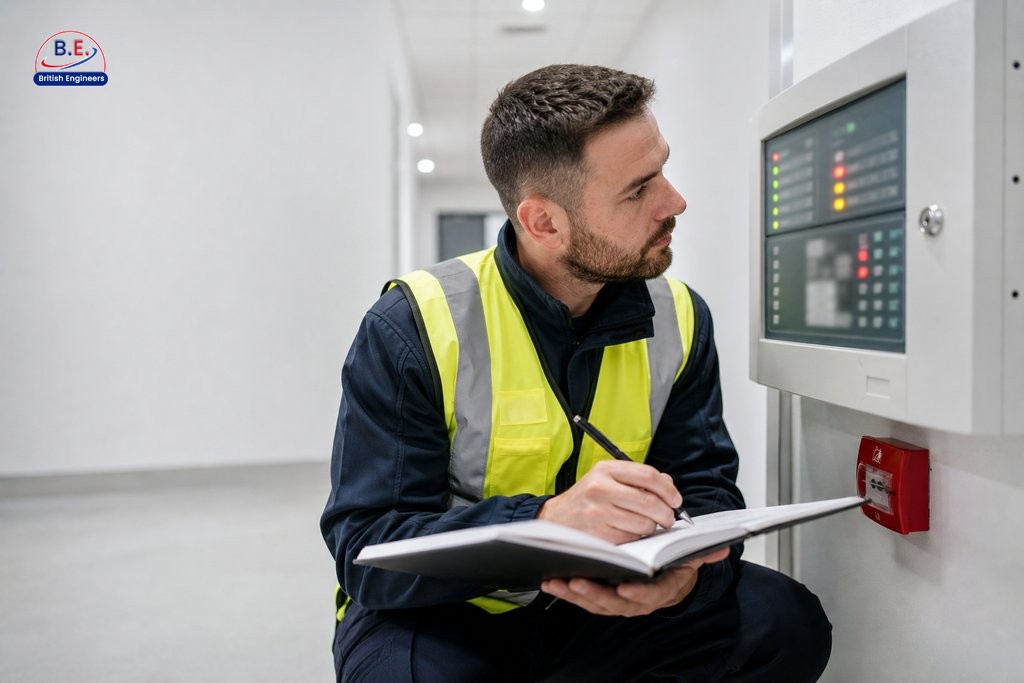
When You Must Use a Certified Fire Alarm Engineer in Manchester
There are situations where professional involvement is a legal requirement, not just good practice. Installing, commissioning, or significantly modifying a fire alarm system must be carried out by a competent person with demonstrated expertise. UK fire safety law requires that any work on your alarm system meets the relevant British Standards, and that the person carrying it out has the qualifications to certify the installation is fit for purpose. Using uncertified labour or unverified equipment is a compliance risk that could invalidate your insurance and expose you to enforcement action.
When selecting an installer, look for evidence of relevant industry certifications, a clear process for system commissioning and handover, and full documentation to support your ongoing compliance. As fire alarm regulations make clear, a system is only as reliable as the engineer who installs and maintains it.
What British Engineers Does Differently
At British Engineers, we approach every fire alarm project in Manchester and across the North West with a personalised consultation that reflects the specific layout, occupancy, and risk profile of your premises. We do not offer generic packages or one-size-fits-all solutions.
Our certified engineers assess your building properly, recommend the appropriate system category based on your fire risk assessment findings, and carry out installations that meet current British Standards from start to finish. We also provide long-term maintenance support, including scheduled servicing, log book management, and rapid response to faults, so your compliance does not end on installation day. Our transparent quotations mean you know exactly what you are paying for, with no hidden costs.
Key Questions to Ask Before Choosing a Fire Alarm Provider
Choosing the right fire alarm provider directly affects your legal standing and the safety of everyone in your building. Before committing to any installer, confirm that their engineers are certified and that evidence of qualifications is available. Ask whether they carry out a site survey and fire risk assessment review before specifying a system, whether their installation complies with BS 5839-1 and BS EN 54 standards, whether they provide a full commissioning certificate and all documentation for your log book, and whether they offer ongoing maintenance contracts including the six-monthly professional service required under current standards.
An installer who cannot answer these questions with confidence is unlikely to deliver the standard your premises legally requires. Underspecified systems and poor aftercare are among the most common reasons businesses fall out of compliance during routine inspections. The right provider will treat your fire safety as an ongoing commitment, not a completed transaction.
If you are ready to ensure your Manchester business meets all its fire alarm requirements, contact British Engineers today. Our team is ready to carry out a personalised assessment, answer your questions honestly, and design a system that keeps your people safe and your premises compliant for the long term.
Frequently Asked Questions About Fire Alarm Requirements for Businesses
Are businesses legally required to have a fire alarm system in the UK?
Yes. Under the Regulatory Reform (Fire Safety) Order 2005, virtually all non-domestic premises must have an appropriate fire detection and warning system. The specific type required depends on your fire risk assessment, building size, occupancy, and the nature of activities carried out on the premises.
Who is responsible for fire alarm compliance in a commercial building?
The responsible person, typically the business owner, employer, or the individual in control of the premises, holds legal liability for fire safety compliance. This includes ensuring the alarm system is appropriate, properly maintained, and that staff are trained on evacuation procedures.
How often does a commercial fire alarm need to be tested and serviced?
Under BS 5839-1:2025, fire alarms must be tested weekly by a designated person on site and professionally serviced every six months by a qualified engineer. All tests, service visits, and faults must be recorded in a fire alarm log book and made available for inspection.
What is BS 5839-1 and why does it matter for my business?
BS 5839-1 is the British Standard covering the design, installation, commissioning, and maintenance of fire detection and alarm systems in non-domestic premises. Compliance is expected under UK fire safety law and is a key reference point during enforcement inspections.
What happens if my business does not comply with fire alarm regulations?
Non-compliance can result in enforcement notices, substantial fines, invalidated insurance, and in serious cases, criminal prosecution. Fire and Rescue Authorities have the power to inspect commercial premises and issue improvement or prohibition notices where fire safety standards are not met.
Does a small business with few employees still need a formal fire alarm system?
Yes, though the type of system required may be simpler. Even small premises must carry out a fire risk assessment and implement appropriate detection and warning measures. A manual warning system may suffice in some low-risk cases, but this must be confirmed through a proper risk assessment rather than assumed.