Key Takeaways
UK fire alarm installation standards set legally backed requirements for system design, grading, and compliance that every homeowner and property manager should understand before commissioning any work.
- BS 5839 is the primary British Standard governing fire alarm installation and applies to all UK properties; Part 1 covers non-domestic buildings while Part 6 covers individual dwellings, so identifying the correct part is the essential first step.
- Fire detection design standards define system categories from L1 to L5 for life protection and P categories for property protection, with detector placement and coverage determined by occupancy, layout, and specific risk factors.
- Alarm system grading runs from Grade A for complex commercial installations with full control panels down to Grade F for simple standalone battery detectors, and selecting the wrong grade can result in both under protection and legal non-compliance.
- Before any installation begins, property owners should confirm the contractor holds relevant qualifications, ideally registered with BAFE, and should request a commissioning certificate, as-installed drawings, and a system logbook on completion.
- HMOs, commercial premises undergoing change of use, and properties being converted or extended often trigger mandatory reassessment obligations, making professional site-specific fire risk assessments essential rather than optional in these cases.
Understanding fire alarm installation standards is one of the most important steps any property owner or manager can take before commissioning a new system. Whether you are protecting a family home in Didsbury or managing a commercial premises in the Northern Quarter, the standards governing what gets installed, where, and by whom are not simply advisory guidance. They form the foundation of fire safety compliance across the UK, and getting them wrong carries real consequences for the people inside your building.
This guide breaks down the key requirements in plain, accessible language. It covers the legislation behind the standards, how systems are categorised and graded, and what you should confirm before any installation work begins. Where professional judgment is essential, this guide says so clearly rather than oversimplifying decisions that deserve expert input.
Why Fire Alarm Installation Standards Matter for Manchester Properties
Fire alarm installation standards exist because properly designed and correctly installed systems save lives. Research published by ScienceDirect found that mandatory smoke alarm installation across Germany’s 16 federal states was associated with a measurable reduction in residential fire fatality risk. In the UK, the same principle underpins how fire alarm requirements are structured and why regulators treat non-compliance seriously.
Beyond life safety, there are direct legal obligations for many property types. Under the Regulatory Reform (Fire Safety) Order 2005, the responsible person for a non-domestic premises must carry out a suitable fire risk assessment and implement appropriate fire safety measures, including ensuring that any fire detection and alarm system is fit for purpose, properly installed, and maintained in working order. For homeowners across Greater Manchester, obligations vary depending on tenure and property type, but following published standards is strongly advisable regardless of whether it is a regulatory requirement or best-practice guidance.
What Is BS 5839 and Does It Apply to You?
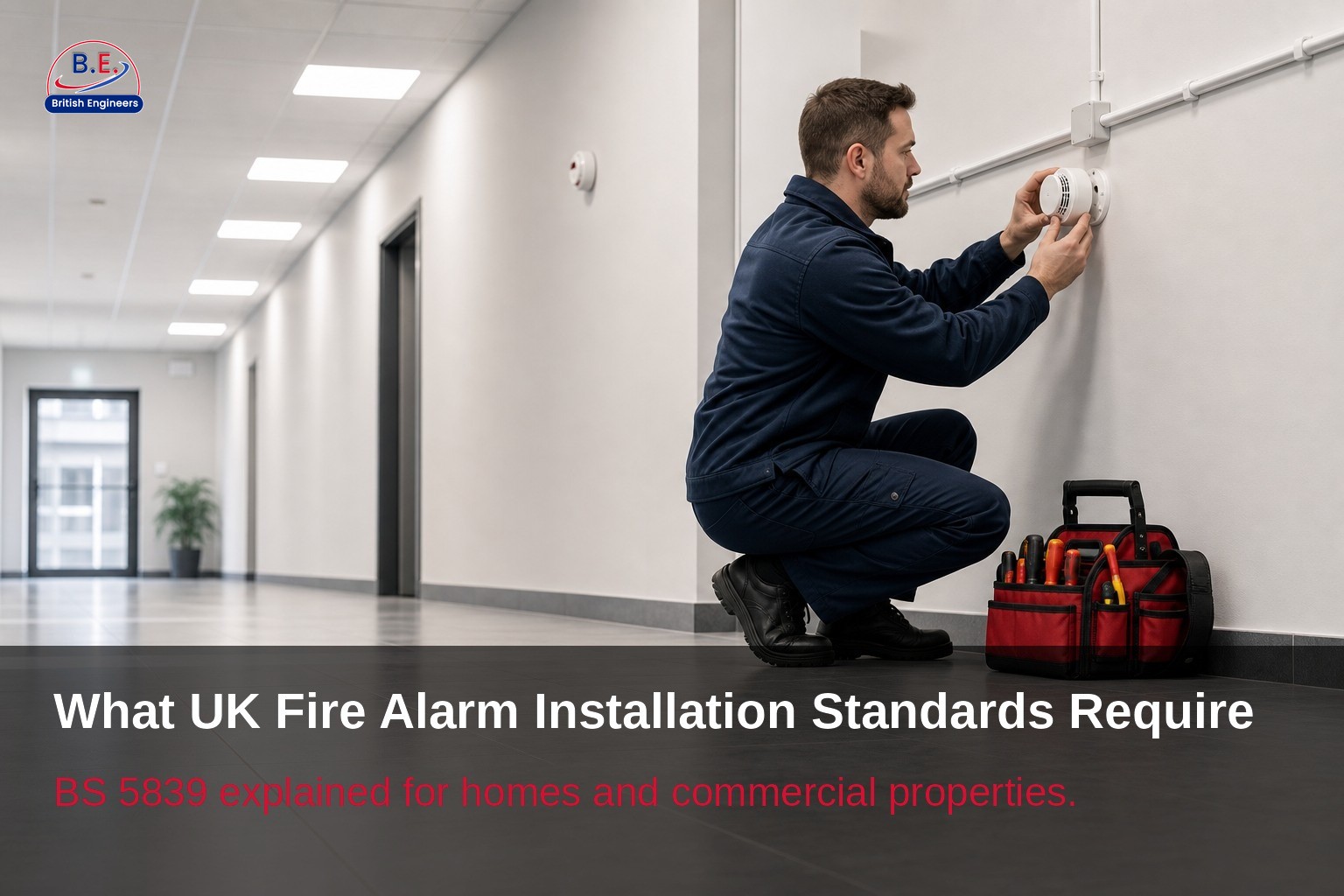
BS 5839 is the British Standard published by BSI Group. It sets out requirements for the design, installation, commissioning, and maintenance of fire detection and alarm systems in the UK. It is the primary technical document that qualified engineers work to when designing any compliant system. The UK government recommends that all fire alarm systems be installed and maintained in accordance with BS 5839, making it the practical benchmark for compliance even when it is not directly cited in legislation.
The standard is divided into several parts, each addressing a different property type or system component. For most property owners and managers, two parts are particularly relevant.
BS 5839 Part 1 vs Part 6: Which Applies to Your Property?
BS 5839 Part 1 covers fire detection and alarm systems in buildings other than dwellings, including commercial premises, offices, warehouses, retail units, houses in multiple occupation (HMOs), and other non-domestic settings. If you are responsible for a business property or a managed residential block in Greater Manchester, Part 1 governs your installation.
BS 5839 Part 6 addresses fire detection and alarm systems in individual dwellings occupied by one household. It is less complex in scope but equally important for homeowners who want a system that meets recognised safety expectations. If you are a homeowner looking to install or upgrade a fire alarm, Part 6 is the relevant starting point.
Identifying which part applies before approaching a contractor helps you ask more informed questions and evaluate responses with greater confidence.
| Standard | Applies To | Typical Property Examples |
|---|---|---|
| BS 5839 Part 1 | Non-domestic buildings and managed residential blocks | Offices, warehouses, retail units, HMOs, commercial premises |
| BS 5839 Part 6 | Individual dwellings occupied by one household | Owner-occupied homes, single-household rented properties |
Fire Alarm System Categories Explained
Fire detection design standards do not simply require detectors somewhere in a building. They define where detectors must be placed, what types are appropriate for each environment, and how overall coverage is assessed.
Under BS 5839-1, systems are categorised by their primary purpose:
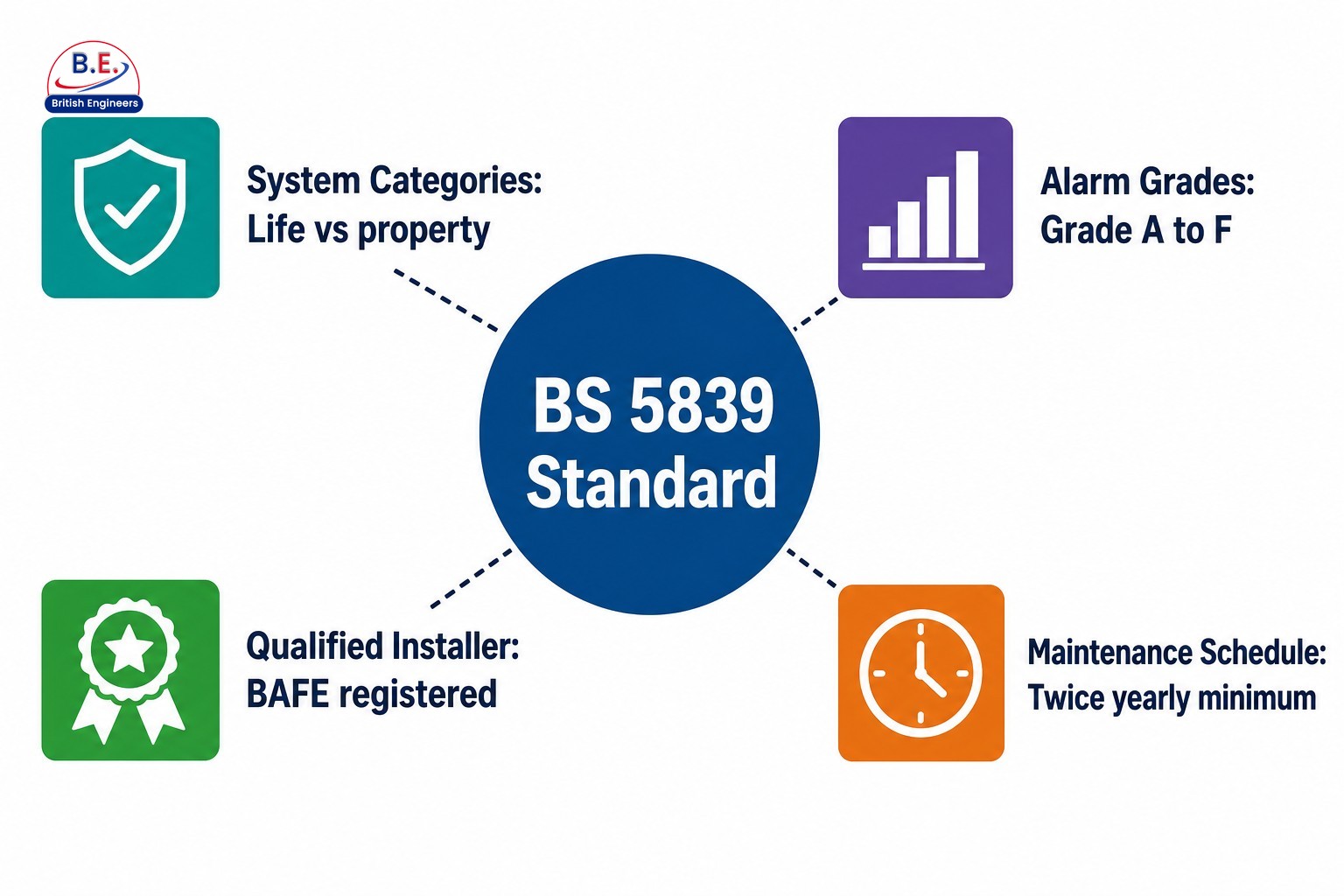
- Category L (Life protection): Designed to protect occupants, with sub-categories from L1 (highest coverage throughout the building) to L5 (specific high-risk areas only).
- Category P (Property protection): Designed to trigger early enough to allow intervention before significant damage occurs.
The category determines where detectors must be placed and how comprehensive coverage needs to be. A qualified engineer will assess your building and recommend the appropriate category based on occupancy, layout, and specific risk factors. Smoke detectors, heat detectors, and multi-sensor devices each have different response characteristics. A kitchen, for example, typically requires a heat detector rather than a smoke detector to avoid nuisance triggers from cooking.
Alarm System Grading: A Simple Breakdown
System grading describes the technical complexity and resilience of a fire alarm installation. Grades run from Grade A (most complex) to Grade F (simplest), and the grade affects everything from control panel requirements to how detectors are interconnected and whether remote monitoring is included.
- Grade A: Full control panel with addressable or conventional detector loops, often including remote signalling to an alarm receiving centre. Typical in larger commercial buildings.
- Grade D: Mains-powered detectors with battery backup, interconnected without a central panel. Common in domestic settings.
- Grade F: Standalone battery-operated detectors with no interconnection. The simplest option available.
The BRE (Building Research Establishment) noted in an official briefing paper that “the manner in which Fire Detection and Fire Alarm Systems are procured and maintained often results in major areas of non-compliance with BS 5839-1, including non-compliances that might create the potential for false alarms.” Grade selection directly affects how a system performs under real conditions. It is not a purely technical formality.
| Grade | System Type | Interconnection | Typical Use |
|---|---|---|---|
| Grade A | Full control panel (addressable or conventional) | Yes, with optional remote signalling | Larger commercial buildings |
| Grade D | Mains-powered detectors with battery backup | Yes, without central panel | Domestic properties |
| Grade F | Standalone battery-operated detectors | No | Simplest residential applications |
How to Choose the Right Grade for Your Property
Several factors influence which grade is appropriate:
- Property size and number of floors
- Occupancy type, including whether occupants are asleep during high-risk periods
- Whether the property is domestic, commercial, or mixed-use
- Existing electrical infrastructure and cabling routes
- Whether remote monitoring is required by insurers or regulators
A certified engineer must confirm the appropriate grade following a proper site assessment. Choosing a grade without professional input risks both under-protection and non-compliance.
What to Check Before Installation Begins
Before any contractor starts work, there are several practical checks every property owner should carry out.
Key Questions to Ask Your Fire Alarm Contractor
- Which part and category of BS 5839 will the installation comply with, and why?
- What grade of system is being specified, and what evidence supports that recommendation?
- Will a commissioning certificate be provided on completion?
- What documentation will be handed over, including as-installed drawings and the system logbook?
- What ongoing maintenance arrangements are available?
Confirming that the engineer holds relevant qualifications is the first priority. Competent persons carrying out fire alarm work should ideally be registered with a recognised body such as BAFE (British Approvals for Fire Equipment), which is a meaningful indicator that the engineer understands and applies current standards. Research published by the National Institute of Standards and Technology found that installation programmes prioritising proper installation quality were associated with lower fire casualty rates compared to control groups. The quality and completeness of installation work directly affects outcomes, which is why documentation and commissioning evidence are essential.

When You Must Consult a Qualified Professional
This guide provides a reliable overview to help property owners and managers understand the standards landscape before engaging a professional. It does not replace a site-specific fire risk assessment and should not substitute for a certified engineer’s judgment on your specific property. Fire alarm regulations explained at a general level are a useful starting point, but every building has characteristics that affect what is actually required.
Professional input is not optional in the following situations:
- HMOs: Subject to specific licensing conditions that often mandate particular alarm categories and grades.
- Change of use: Commercial premises undergoing change of use may require a completely new system design.
- Conversions, extensions, or refurbishments: These frequently trigger reassessment obligations.
Relying on general guidance in these situations risks a system that is both legally non-compliant and practically inadequate. The UK Home Office reported that 42% of fire and rescue service incidents in England for the year ending June 2020 were false alarms, a figure that reflects how often systems fall short when their design or installation does not meet the required standard.
How British Engineers Approaches Fire Alarm Installation in Manchester
At British Engineers, every fire alarm project begins with a consultative assessment of the specific property rather than a generic package applied without thought. We assess the layout, occupancy, and risk profile of each property individually before recommending a system category, grade, and detector specification that fits your situation.
All installation work is carried out by certified engineers using quality equipment, ensuring that what goes into your property meets both the technical requirements of BS 5839 and the performance expectations you have every right to hold. We provide full documentation on completion, including commissioning certificates and as-installed records, so you have the evidence of compliance you may need for insurers, licensing authorities, or future property transactions.
Fire alarm requirements for businesses and homeowners alike do not end at installation. Ongoing maintenance is what keeps a system reliable over time, and we offer continued support to make sure your system performs when it matters most.
If you are ready to discuss a fire alarm installation for your Manchester property, whether a family home in Chorlton, a commercial unit in Ancoats, or a managed block in Salford, contact British Engineers today. We are here to make the process straightforward, the compliance clear, and the outcome something you can rely on.
Frequently Asked Questions About Fire Alarm Installation Standards
What is BS 5839 and why does it matter for UK fire alarm installations?
BS 5839 is the British Standard that sets out requirements for designing, installing, commissioning, and maintaining fire detection and alarm systems. It is the primary technical benchmark used by qualified engineers across the UK. Even where it is not directly cited in legislation, the UK government recommends compliance with BS 5839 as the accepted measure of a properly installed system.
Do I need a fire alarm system in my home in Manchester?
There is no single legal requirement for homeowners to install a professionally designed fire alarm system, but following BS 5839 Part 6 is strongly recommended. For rented properties, landlords have legal obligations that typically require working smoke and carbon monoxide alarms. HMOs are subject to additional licensing conditions that specify alarm categories and grades.
What is the difference between a Category L and Category P fire alarm system?
Category L systems are designed to protect occupants, with coverage ranging from the entire building (L1) to specific high-risk areas (L5). Category P systems are designed primarily to protect property by detecting fire early enough to allow intervention. A qualified engineer will recommend the appropriate category based on your building’s occupancy and risk profile.
Who is qualified to install a fire alarm system to BS 5839 standards?
Fire alarm installations should be carried out by engineers registered with a recognised competency scheme. BAFE (British Approvals for Fire Equipment) is the most widely recognised body in the UK for this purpose. Engaging an unregistered installer increases the risk of non-compliance and may affect your insurance position or licensing obligations.
What documentation should I receive after a fire alarm installation?
A compliant installation should include a commissioning certificate confirming the system has been tested and meets the specified standard. You should also receive as-installed drawings, a system logbook, and information about ongoing maintenance requirements. These documents are often required by insurers, licensing authorities, or when selling or letting the property.
How often does a fire alarm system need to be maintained?
BS 5839 recommends that fire alarm systems in non-domestic premises are inspected and tested at least twice a year by a competent engineer. Weekly testing of manual call points and regular checks of the control panel are also expected as part of routine in-house maintenance. Maintenance schedules for domestic systems are less prescriptive, but regular testing remains important.